

Now Reading: X Money Is Live and William Shatner Is Handing Out Invites: Here Is What Elon Musk’s Payments App Actually Does
-
01
X Money Is Live and William Shatner Is Handing Out Invites: Here Is What Elon Musk’s Payments App Actually Does
X Money Is Live and William Shatner Is Handing Out Invites: Here Is What Elon Musk’s Payments App Actually Does

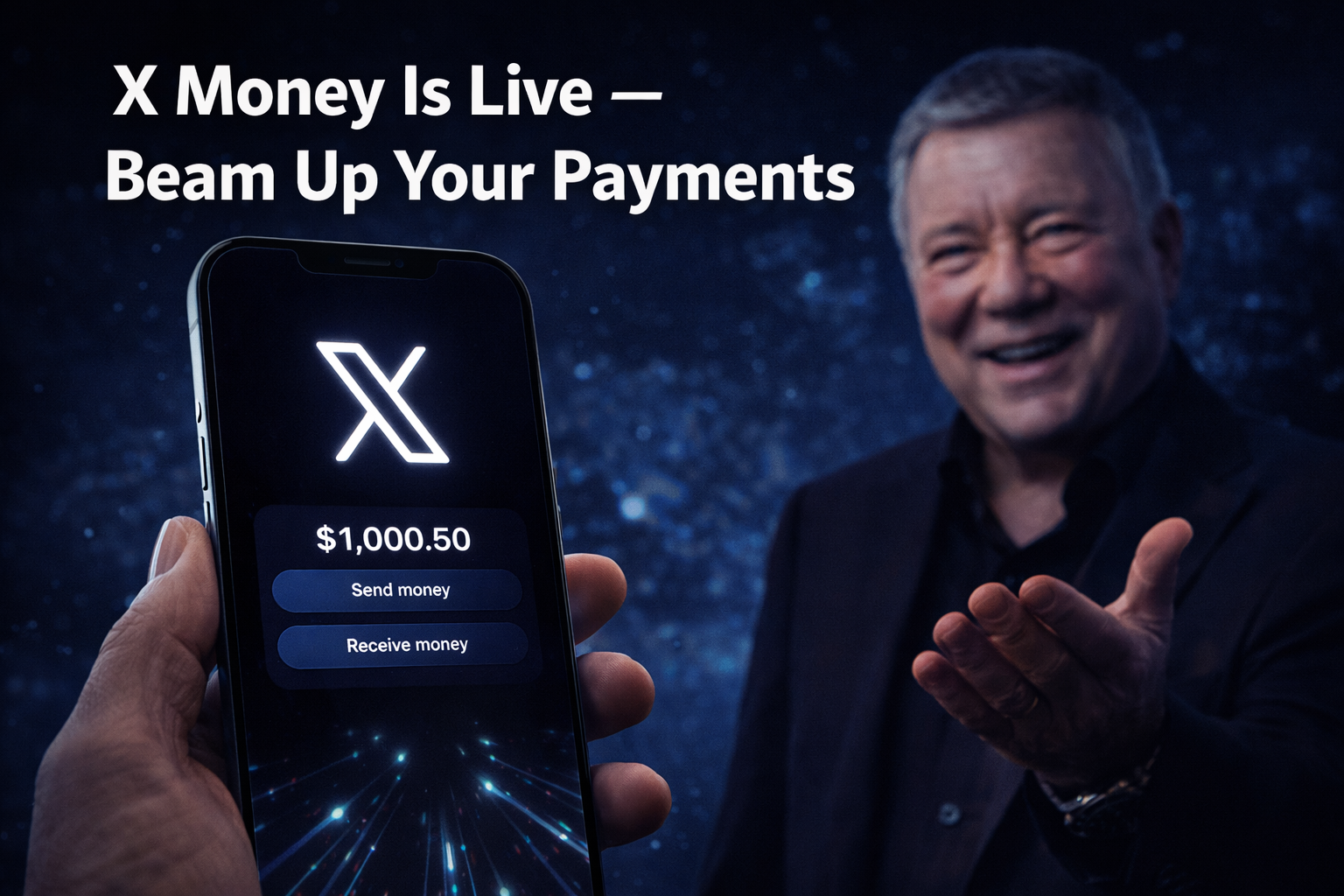
Elon Musk’s vision for X as an everything app has been publicly stated and extensively discussed since he acquired Twitter in 2022. The payments layer has always been central to that vision: Musk built his first fortune at X.com, which became PayPal, and has spoken repeatedly about his belief that a social platform with integrated payments can capture the kind of financial services market share that WeChat achieved in China.
Thank you for reading this post, don't forget to subscribe!X Money is the first serious step toward making that vision operational. The service has launched with a graduated invite system, and in one of the more unusual marketing choices in recent fintech history, William Shatner has been tapped to distribute invites to the service. Here is what X Money actually offers, how it compares to established payment apps, and what it would need to achieve Musk’s ambitions.
What X Money Actually Is
X Money is a peer-to-peer payment service integrated directly into the X platform, allowing users to send and receive money through the same app they use for social content. In its initial form, the service supports linking bank accounts or debit cards, sending money to other X users, and holding a balance within the X Money account.
The integration with X’s social layer is the key differentiator from standalone payment apps. When you interact with content from a creator, business, or individual on X, the payment option is immediately accessible without switching apps. Tipping creators, paying for event tickets promoted on X, or splitting costs with people you are already conversing with on the platform are all use cases that the integrated approach enables more naturally than a separate payment app.
The Financial Infrastructure Behind X Money
X Money operates through partnerships with established financial infrastructure rather than building its own banking licenses from scratch. The service uses regulated payment processing partners to handle the actual movement of funds, which is the standard approach for fintech apps that want to launch quickly without navigating the multi-year process of obtaining banking licenses.
X has been building its financial services regulatory framework across multiple US states, obtaining money transmission licenses that are required to legally operate a payments service. This groundwork has been underway since the Twitter acquisition and represents the compliance infrastructure that makes X Money legally operational rather than just technically capable.
The WeChat Comparison: WeChat Pay in China processes trillions of dollars in transactions annually and is used for everything from restaurant bills to utility payments within a single super-app. Musk has explicitly cited WeChat as the model for X’s everything-app ambitions. Whether the US market, with its different regulatory environment and already-established payment app habits, is receptive to this model is the central commercial question.
Why William Shatner? The Invite Strategy Explained
The decision to use William Shatner as an invite distributor for X Money is simultaneously a marketing stunt, a community signal, and a practical distribution mechanism. Shatner has maintained an unusually active and authentic presence on X/Twitter, engaging genuinely with followers across decades of the platform’s history. His willingness to participate in X Money’s launch signals a partnership between X and its most historically engaged celebrity users.
The invite model itself, limiting initial access and creating distribution through trusted community members, is a classic early-stage consumer service growth technique. It creates scarcity that drives interest, allows X to manage the operational scale-up of the payments infrastructure, and generates social content as invite recipients discuss and share their access.
How X Money Compares to Established Payment Apps
Venmo: Venmo’s social feed and college-demographic penetration give it cultural entrenchment that X Money will find hard to displace. Venmo is owned by PayPal and deeply embedded in how younger Americans split social expenses.
Cash App: Block’s Cash App has expanded beyond P2P payments into banking, investing, and Bitcoin, with strong penetration in the underbanked demographic. Its standalone identity is a different positioning than X Money’s social-integrated approach.
PayPal: PayPal dominates e-commerce payment flows and business payments. X Money’s social-first approach targets a different use case than PayPal’s primary strength.
Apple Pay / Google Pay: Device-level payment integrations that handle the point-of-sale use case. X Money does not compete directly with these at the hardware level but competes for the digital payment wallet share of attention.
The Everything App Challenge in the US Market
The fundamental challenge for X Money, and for X’s everything-app ambitions more broadly, is that the US market has highly developed, deeply embedded single-purpose apps for every function that super-apps combine. Americans have Venmo for P2P payments, Spotify for music, Instagram for photos, and DoorDash for food delivery. The behavioral switching cost of moving all of these functions into X is substantial even if X’s integrated versions are technically comparable.
WeChat succeeded in China partly because it entered a market without entrenched single-purpose alternatives and partly because it benefited from network effects in a market where the regulatory environment limited foreign competition. Neither condition applies in the US, which makes X Money’s path to WeChat-scale adoption significantly harder than Musk’s stated aspiration implies.
What X Money Needs to Succeed
- Creator monetization integration: If X makes tipping and direct creator payment seamless for the creators with large X followings, adoption follows the audience
- Business payments: Enabling small businesses and event organizers already using X for marketing to accept payment through the same platform removes friction
- Interest on balances: Offering competitive yields on X Money balances would differentiate it as a financial product rather than just a payment mechanism
- International expansion: P2P payment across borders where traditional services are expensive or unavailable is a genuinely underserved market
Bottom Line: X Money is a real product with real financial infrastructure, not just a concept. The William Shatner invite strategy is unconventional but consistent with X’s community-first approach. Whether it achieves WeChat-scale ambitions depends on whether X can solve the behavioral entrenchment problem that standalone payment apps have created in the US market. This launch is the beginning of a very long competition.
Related: Elon Musk Founder Power | Silicon Valley Political Crisis | Post-Hype Crypto Market 2025
Stay Informed With the Latest & Most Important News



Top News
- Google’s AI-Powered Workspace in Search Is Now Available to All US Users: Here Is What Actually Changed

- How Jeffrey Epstein Used Silicon Valley’s Network: What the Reporting on Reid Hoffman and Tech’s Elite Reveals

- Where to Preorder the iPhone 17E Right Now: Every Deal Ranked Before the March 11 Launch
- Google Apps Experience and Games Level Up: The Programs That Could Cut Your Play Store Commission Significantly
- Google Is Not Waiting for a Settlement: It Just Killed the 30 Percent App Store Fee Unilaterally











Advertisement