
Now Reading: Why the Best AI Researchers Are Leaving OpenAI and xAI: The Real Story Behind the Exodus
-
01
Why the Best AI Researchers Are Leaving OpenAI and xAI: The Real Story Behind the Exodus
Why the Best AI Researchers Are Leaving OpenAI and xAI: The Real Story Behind the Exodus

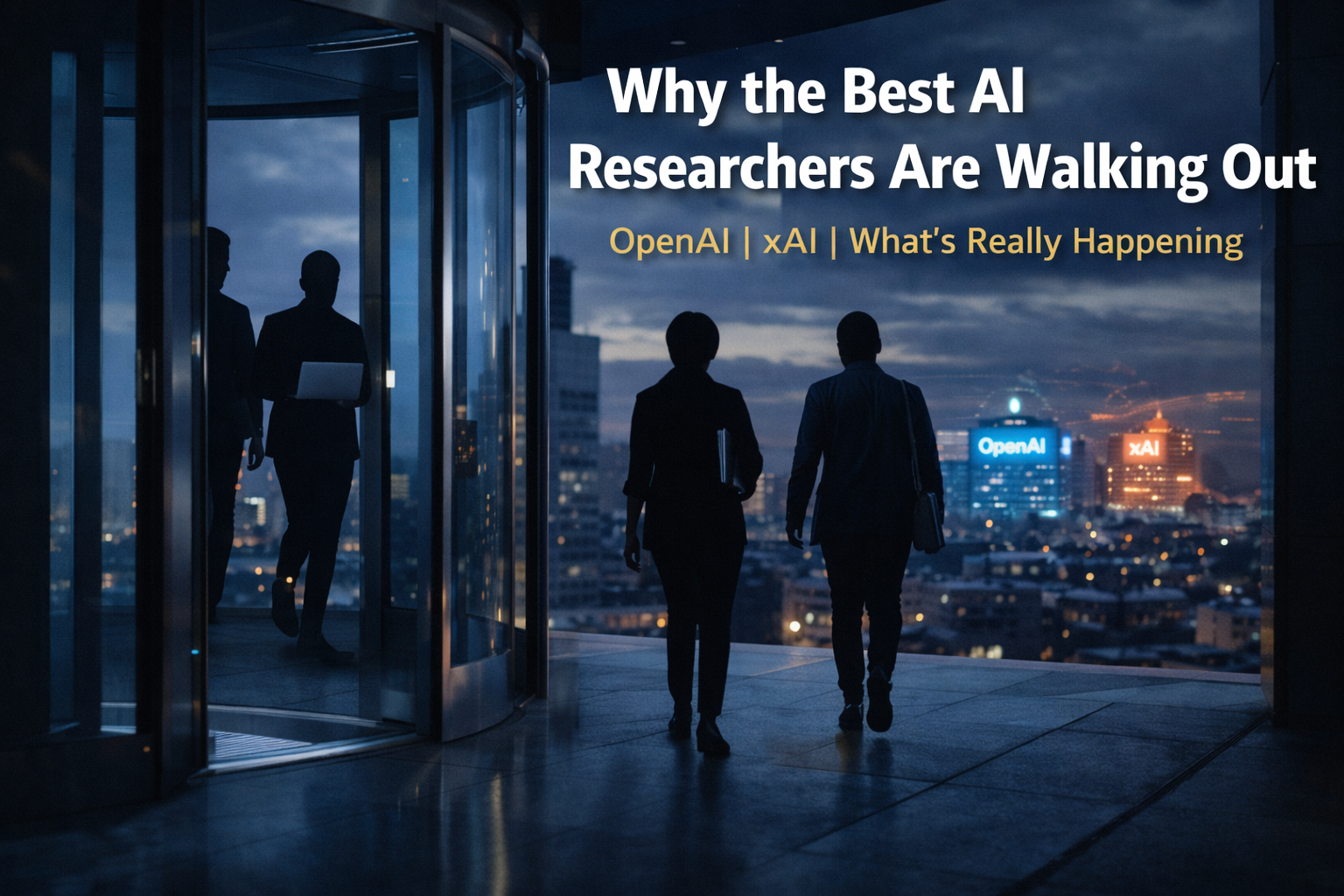
Talent turnover at technology companies is normal. At the frontier AI labs, where the work is both uniquely consequential and uniquely well-compensated, turnover is not just a human resources metric. It is a signal about the organizational health, cultural direction, and research priorities of the institutions that are building the most powerful AI systems in the world.
Thank you for reading this post, don't forget to subscribe!The pattern of departures from both OpenAI and xAI over the past 18 months has been notable enough that it warrants examination beyond the individual announcements. Who is leaving, why they are leaving, and where they are going tells a specific story about the tensions at the center of frontier AI development.
The OpenAI Departure Pattern
The Safety Researchers Who Left
The most prominent category of OpenAI departures has been safety-oriented researchers who have publicly or semi-publicly indicated that their reasons for leaving related to concerns about the organization’s direction on safety practices, the commercialization pace relative to safety research investment, and the governance changes following the 2023 board crisis.
Ilya Sutskever, one of OpenAI’s co-founders and its chief scientist until his departure, had been closely associated with the board’s safety-focused faction. His departure, and the subsequent departure of other senior safety researchers, represented a significant change in OpenAI’s internal safety leadership. The researchers who left did not simply find other opportunities. Several have made statements or started new organizations specifically focused on AI safety research, indicating that the concern about OpenAI’s direction was substantive rather than circumstantial.
The Commercial Culture Tension
A second category of departures reflects a more general tension between research culture and commercial culture that becomes acute as AI labs scale and commercialize. Frontier AI research requires long time horizons, tolerance for projects that do not produce commercially valuable results, and intellectual freedom to pursue directions that might not fit the current product roadmap.
As OpenAI has grown from a research organization to a commercial company with hundreds of millions of paying customers, significant government contracts, and investor return expectations, the organizational culture has shifted in ways that make it a less natural home for researchers whose primary motivation is scientific progress rather than product development. This is a predictable tension, not a unique OpenAI failure, but it has accelerated departures by researchers who chose OpenAI specifically for its research-first original identity.
The Research vs. Product Gradient: Every AI lab exists somewhere on a gradient between pure research organization and product company. OpenAI has moved significantly toward the product end of that gradient since its founding. For researchers who joined when it was further toward the research end, the current culture represents a genuine change in what the organization is and what it is for.
The xAI Departure Pattern
xAI’s departure pattern is different in character from OpenAI’s. The company is newer, has moved faster, and has Musk’s characteristically demanding and mercurial leadership style as a constant backdrop. The departures from xAI reflect both the natural volatility of a rapidly growing startup operating in a high-pressure environment and specific concerns about working under Musk that are distinct from the safety-versus-speed tension at OpenAI.
Employees who have left xAI have cited the extreme working hours culture, the unpredictability of priorities driven by Musk’s personal interests and public statements, the challenge of maintaining technical rigor under pressure to ship quickly, and concerns about where xAI’s capabilities might be applied given Musk’s concurrent involvement in government through DOGE.
The Government Adjacency Problem
Both OpenAI’s DoD partnership and xAI’s proximity to government through Musk’s DOGE role have created departure triggers for researchers who joined these organizations with the expectation that their work would be oriented toward broadly beneficial applications rather than military or government surveillance uses.
For researchers with backgrounds in civil liberties, academic institutions, or safety-focused organizations, the normalization of government and military AI partnerships represents a line that shifts the nature of their work in ways they did not agree to when they joined. Several researchers who have left both organizations have been explicit, in public statements or in conversations that have been reported, that this factor played a role in their decision.
Where Departing Researchers Are Going
The destination pattern of AI talent departing the major labs is itself informative. The primary destinations break into four categories:
New safety-focused organizations: Several departing OpenAI safety researchers have started or joined new organizations specifically focused on AI alignment and safety research with more independence from commercial pressures.
Academic institutions: Research universities are experiencing an unusual period of competitive advantage in AI talent because they can offer intellectual freedom and long-term research orientation that commercial labs increasingly cannot.
Competitor labs: Anthropic, Google DeepMind, and smaller frontier labs have all benefited from OpenAI and xAI departures, attracting researchers who want to continue frontier AI work in different organizational cultures.
New AI startups: Several departing researchers have started new companies in categories ranging from AI safety tooling to specialized AI applications to new foundation model development.
What This Means for the AI Industry
The departure of safety-oriented researchers from OpenAI is the most consequential aspect of the talent movement for long-term outcomes. Safety research requires deep understanding of the specific systems being studied, which means researchers who leave the lab building the most capable systems lose access to the very systems most relevant to their safety research.
The dispersion of frontier AI talent across more organizations, while creating research diversity, also creates coordination challenges. The organizations best positioned to study the safety properties of the most capable AI systems are the ones building those systems. When safety-oriented researchers and capability-oriented researchers are in the same organization, there is at least the possibility of productive tension and mutual influence. Separated into different organizations, both the capability development and the safety research proceed with less cross-pollination.
Bottom Line: The talent exodus from OpenAI and xAI is a symptom of genuine organizational tensions that are not easily resolved: safety culture versus commercial culture, research freedom versus product delivery pressure, and the ethics of government partnerships versus the commercial opportunities they represent. Where this talent goes and what it builds will shape the AI landscape over the next decade.
Related: AI Culture Wars Explained | OpenAI Pentagon Deal Backlash | Anthropic Pentagon Blacklist
Related Posts

Stay Informed With the Latest & Most Important News



Top News
- Google’s AI-Powered Workspace in Search Is Now Available to All US Users: Here Is What Actually Changed

- How Jeffrey Epstein Used Silicon Valley’s Network: What the Reporting on Reid Hoffman and Tech’s Elite Reveals

- Where to Preorder the iPhone 17E Right Now: Every Deal Ranked Before the March 11 Launch

- Google Apps Experience and Games Level Up: The Programs That Could Cut Your Play Store Commission Significantly

- Google Is Not Waiting for a Settlement: It Just Killed the 30 Percent App Store Fee Unilaterally














Advertisement