
Now Reading: There Is Now an App That Tells You When Smart Glasses Are Recording You: Here Is How It Works
-
01
There Is Now an App That Tells You When Smart Glasses Are Recording You: Here Is How It Works
There Is Now an App That Tells You When Smart Glasses Are Recording You: Here Is How It Works

The privacy implications of smart glasses have been a theoretical concern since Google Glass appeared in public in 2013 and prompted a backlash from people who did not want to be recorded by someone’s eyewear. Over a decade later, the concern has become concrete. Meta’s Ray-Ban smart glasses are selling in meaningful volumes, Apple’s Vision Pro has established the category’s premium tier, and a wave of AI-enabled smart glasses from startups and established manufacturers are either shipping or imminent.
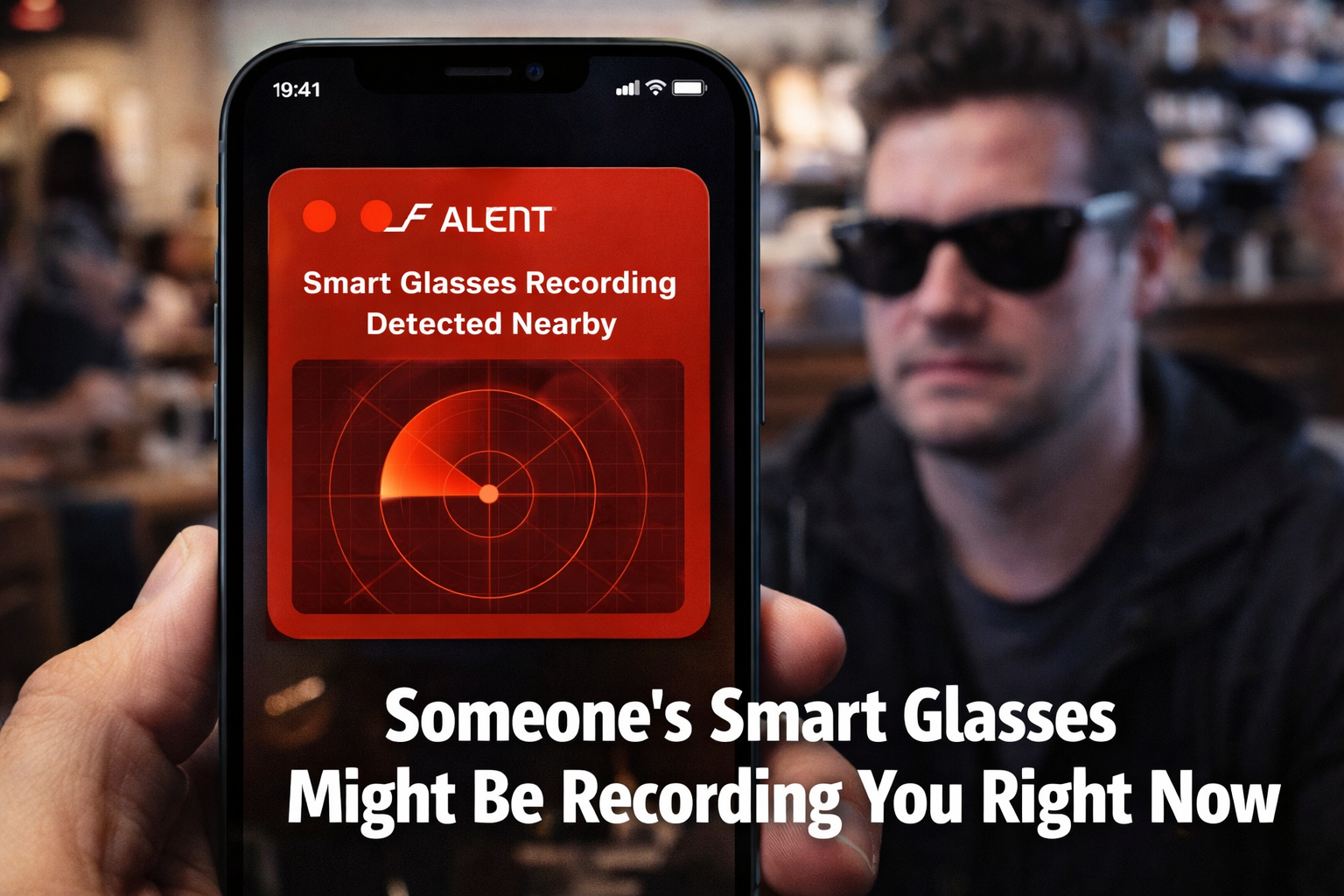
Thank you for reading this post, don't forget to subscribe!The gap between the surveillance capability of increasingly mainstream smart glasses and the public’s ability to know when that capability is being used has produced an inevitable response: an app designed to detect when nearby smart glasses are actively recording and alert users to their presence.
How the Detection App Works
The detection approach exploits a technical characteristic of smart glasses cameras that differs from smartphone cameras: when recording, most current smart glasses emit specific RF signals, infrared signatures, or exhibit detectable Bluetooth and Wi-Fi behavior patterns that can be identified with specialized scanning software running on a standard smartphone.
The app continuously monitors the RF environment for the specific signatures associated with active smart glasses cameras from known manufacturers. When a device matching a known recording-active signature is detected within a defined proximity range, typically under 15 meters, the app generates an alert including an estimated direction and distance to the detected device.
What It Can and Cannot Detect
Currently detectable: Meta Ray-Ban Stories active recording mode, select other Bluetooth-connected smart glasses in recording state, some AR glasses with known RF signatures during camera operation.
Detection limitations: Cannot identify specific individuals wearing detected glasses, cannot determine what is being recorded or whether the recording includes you specifically, may produce false positives from other Bluetooth devices with similar signatures.
Evasion possibilities: Manufacturers can modify transmission patterns through firmware updates, airplane mode operation may reduce detectable signals, custom or modified glasses may not match known signature databases.
Not yet detectable: Future generations of glasses designed with reduced RF emissions, optical-only recording systems, and glasses from manufacturers not yet in the signature database.
The Arms Race Dynamic: Detection apps that rely on specific RF or Bluetooth signatures will trigger a response from manufacturers and privacy-conscious wearers. Future smart glasses may be designed to minimize detectable signals during recording, making detection progressively harder as the technology matures. The app is valuable now; its long-term effectiveness depends on an ongoing technical competition.
The Privacy Rights Landscape for Smart Glasses
The legal framework governing smart glasses recording in public spaces is incomplete and varies significantly by jurisdiction. In the United States, recording in public spaces where there is no reasonable expectation of privacy is generally legal under federal law and most state laws. However, states with two-party consent laws for audio recording create additional complexity for glasses that record audio alongside video.
The EU’s GDPR creates meaningful obligations around the recording and processing of identifiable individuals’ biometric data, which could apply to smart glasses that capture and process facial recognition or biometric information. But enforcement of GDPR against individual wearers of consumer devices is practically challenging.
The Harvard I-XRAY Demonstration
The most alarming public demonstration of smart glasses’ privacy implications came from Harvard students who demonstrated that Meta Ray-Ban glasses could be combined with facial recognition software running on a laptop to identify strangers in public, retrieve their names and addresses from public records, and present the information within seconds of seeing a person’s face for the first time.
The I-XRAY demonstration did not require any hardware modification to the glasses and used publicly available facial recognition APIs and public records databases. It illustrated that the privacy risk of smart glasses is not just the recording capability itself but the combination of that capability with AI processing that can derive sensitive information from recorded faces in real time.
What You Can Do About Smart Glasses Surveillance
- Download a detection app and use it in environments where you have heightened privacy concerns: medical settings, legal consultations, sensitive business meetings.
- Be aware that public spaces in most jurisdictions provide limited legal protection against being recorded by smart glasses.
- If you host events or operate a business where recording is not permitted, post clear signage and include smart glasses in your recording policy.
- Support legislative efforts to require visible recording indicators on wearable cameras, similar to the indicator lights required on some security cameras.
- Consider the social norms you want to reinforce: openly asking someone to stop recording you, while legally uncertain in public, is socially reasonable and often effective.
The Manufacturer Response
Meta has addressed smart glasses privacy concerns by requiring the Ray-Ban glasses to display a white LED indicator light when the camera is actively recording. This indicator light is visible to people in front of the wearer and serves as a conspicuous recording warning. However, the light is small, often overlooked, and can theoretically be physically modified by determined users.
The industry’s self-regulatory approach to smart glasses privacy, voluntary indicator lights and terms of service prohibitions on privacy violations, is unlikely to be sufficient as the technology becomes more capable and more widespread. The detection app market is growing because the self-regulatory approach has not resolved the fundamental tension between the capability of smart glasses to record anyone in their field of view and those people’s interest in knowing when that capability is being exercised.
Bottom Line: Smart glasses recording detection apps represent a market response to a genuine privacy gap that legislation and manufacturer self-regulation have not closed. They are useful now and will face technical challenges as the technology evolves. The broader question, whether smart glasses with always-available recording capability are compatible with reasonable expectations of public privacy – is a social and legal question that technology alone cannot answer.
Related: iPhone Hacking Tools in Criminal Hands | TikTok Privacy and Encryption | LeakBase FBI Shutdown
EFF guide on smart glasses privacy
Related Posts

Stay Informed With the Latest & Most Important News



Top News
- Google’s AI-Powered Workspace in Search Is Now Available to All US Users: Here Is What Actually Changed

- How Jeffrey Epstein Used Silicon Valley’s Network: What the Reporting on Reid Hoffman and Tech’s Elite Reveals

- Where to Preorder the iPhone 17E Right Now: Every Deal Ranked Before the March 11 Launch

- Google Apps Experience and Games Level Up: The Programs That Could Cut Your Play Store Commission Significantly

- Google Is Not Waiting for a Settlement: It Just Killed the 30 Percent App Store Fee Unilaterally













Advertisement