

Now Reading: The World’s Biggest Automaker Has One of the Dirtiest Supply Chains: What the Report Found and What It Means
-
01
The World’s Biggest Automaker Has One of the Dirtiest Supply Chains: What the Report Found and What It Means
The World’s Biggest Automaker Has One of the Dirtiest Supply Chains: What the Report Found and What It Means

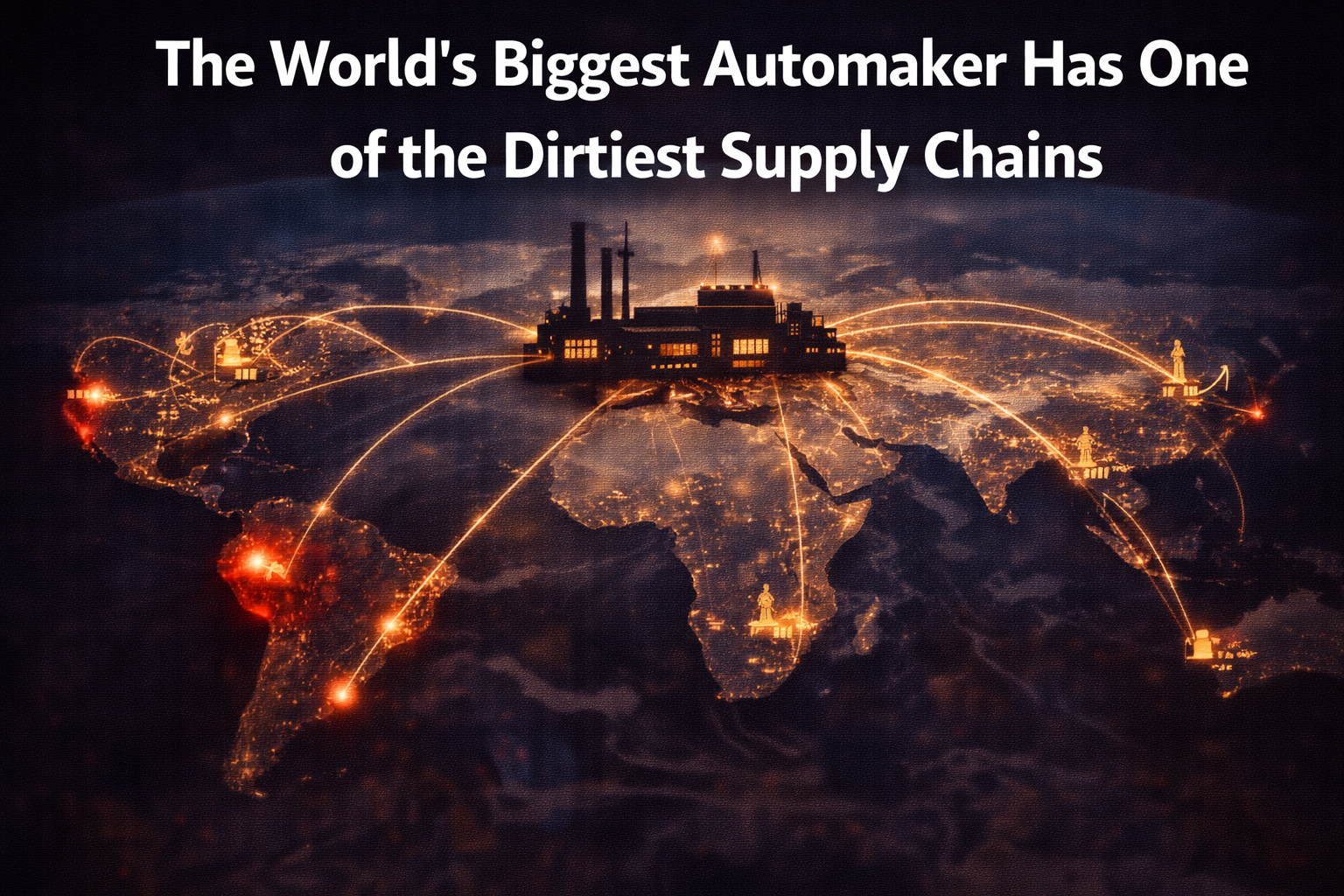
Supply chain emissions, the carbon and environmental impact generated by a company’s suppliers rather than the company’s own operations, are the largest and least visible component of most major manufacturers’ environmental footprint. For automakers, who source steel, aluminum, copper, plastics, electronics, and hundreds of other materials from global supply networks, Scope 3 emissions from those supply chains typically represent 80 to 90 percent of total lifecycle carbon output.
Thank you for reading this post, don't forget to subscribe!A new investigative report examining the supply chain practices of the world’s largest automaker by volume has found that despite years of public sustainability commitments, the company’s supplier network contains some of the most carbon-intensive and ethically problematic operations in the global automotive industry. The findings create uncomfortable questions about the gap between corporate sustainability messaging and supply chain reality.
What the Report Found
Steel and Aluminum: The Biggest Emissions Source
The most significant emissions finding in the report concerns the automaker’s primary steel and aluminum suppliers, whose production processes rely predominantly on coal-fired facilities with emissions intensity well above the industry average for comparable steel and aluminum producers. Steel and aluminum together account for approximately 60 percent of a conventional vehicle’s material weight and are correspondingly the largest material emissions sources in automotive manufacturing.
The report found that the automaker had signed long-term supply agreements with several steel producers who have explicitly delayed or abandoned decarbonization commitments that would be necessary to meet the automaker’s own stated 2050 net-zero supply chain target. The implication is that the company’s public climate commitments are not reflected in its supplier contracting decisions, where cost and reliability have been prioritized over emissions performance.
Mining and Raw Materials
The report’s most ethically charged findings concern mining suppliers, particularly for battery minerals like lithium, cobalt, nickel, and manganese, where the supply chain includes operations with documented environmental violations, labor abuses, and community displacement issues. The sourcing of these minerals from operations with problematic human rights and environmental records creates a direct contradiction with the company’s public commitments to responsible sourcing.
The EV Paradox: Automakers transitioning to electric vehicles are increasing their demand for battery minerals precisely as their sustainability commitments require higher sourcing standards. The combination of growing demand and inadequate supply of responsibly sourced materials creates market pressure that reduces the effective enforcement of responsible sourcing commitments. The clean car revolution has a dirty mining problem.
Tier 2 and Tier 3 Supplier Opacity
The report documented that the automaker’s visibility into its supply chain effectively stops at its direct, tier-1 suppliers. The tier-2 and tier-3 suppliers that provide materials and components to the tier-1 companies operate with minimal oversight from the automaker and have in many cases not signed the company’s supplier code of conduct. The environmental and ethical risks that are hidden at these lower tiers of the supply chain are substantial and, by design, difficult to audit.
How This Compares to Industry Peers
Supply chain sustainability performance varies significantly across automakers. Several European manufacturers, notably Volkswagen and BMW, have invested more heavily in supply chain auditing infrastructure and have been more aggressive in setting supplier decarbonization requirements as contract conditions. Several have launched programs to track battery mineral provenance using blockchain-based verification systems.
The report’s subject lags these peers on supply chain transparency, auditing depth, and the degree to which sustainability performance is incorporated into supplier contracting and selection decisions. The gap is particularly notable given the company’s scale: its supplier leverage to require better practices is among the largest in the industry precisely because of its volume.
The Company’s Response
The automaker’s public response acknowledged the report’s findings in general terms while disputing specific characterizations and emphasizing the company’s existing sustainability commitments. The response highlighted investments in supplier development programs, participation in industry-wide supply chain transparency initiatives, and the company’s 2050 net-zero commitment as evidence of engagement with the issues the report raises.
Critics of the response noted that 2050 net-zero commitments without binding 2030 milestones and supplier contracting requirements that enforce progress toward those milestones are insufficient to change supply chain behavior in the timeline that climate science requires.
What Needs to Change
- Binding 2030 emissions reduction requirements for tier-1 suppliers with enforceable contract consequences for non-compliance
- Mandatory supply chain auditing extended to tier-2 and tier-3 suppliers in high-risk categories
- Public disclosure of supplier-level emissions data with the same transparency as company-level reporting
- Mineral sourcing standards with third-party verification rather than self-certification
- Transition financing support that helps suppliers implement decarbonization without passing the full cost burden to smaller operators
Bottom Line: Being the world’s biggest automaker means having the world’s most significant supply chain leverage to drive sustainability improvements. The gap between the public sustainability commitments and the supply chain contracting reality that this report documents is a gap the company has the power to close faster than it is currently moving. Scale creates responsibility, not just opportunity.
Related: Ford CEO Admits EV Strategy Mistakes | Donut Lab Solid-State Battery | Einride Self-Driving Trucks
Carbon Disclosure Project automotive report
Stay Informed With the Latest & Most Important News
Previous Post
Next Post



Top News
- Google’s AI-Powered Workspace in Search Is Now Available to All US Users: Here Is What Actually Changed

- How Jeffrey Epstein Used Silicon Valley’s Network: What the Reporting on Reid Hoffman and Tech’s Elite Reveals
- Where to Preorder the iPhone 17E Right Now: Every Deal Ranked Before the March 11 Launch

- Google Apps Experience and Games Level Up: The Programs That Could Cut Your Play Store Commission Significantly

- Google Is Not Waiting for a Settlement: It Just Killed the 30 Percent App Store Fee Unilaterally













Advertisement