

Now Reading: The AI Culture Wars: A Complete Guide to the Battles Dividing the Most Important Industry in the World
-
01
The AI Culture Wars: A Complete Guide to the Battles Dividing the Most Important Industry in the World
The AI Culture Wars: A Complete Guide to the Battles Dividing the Most Important Industry in the World

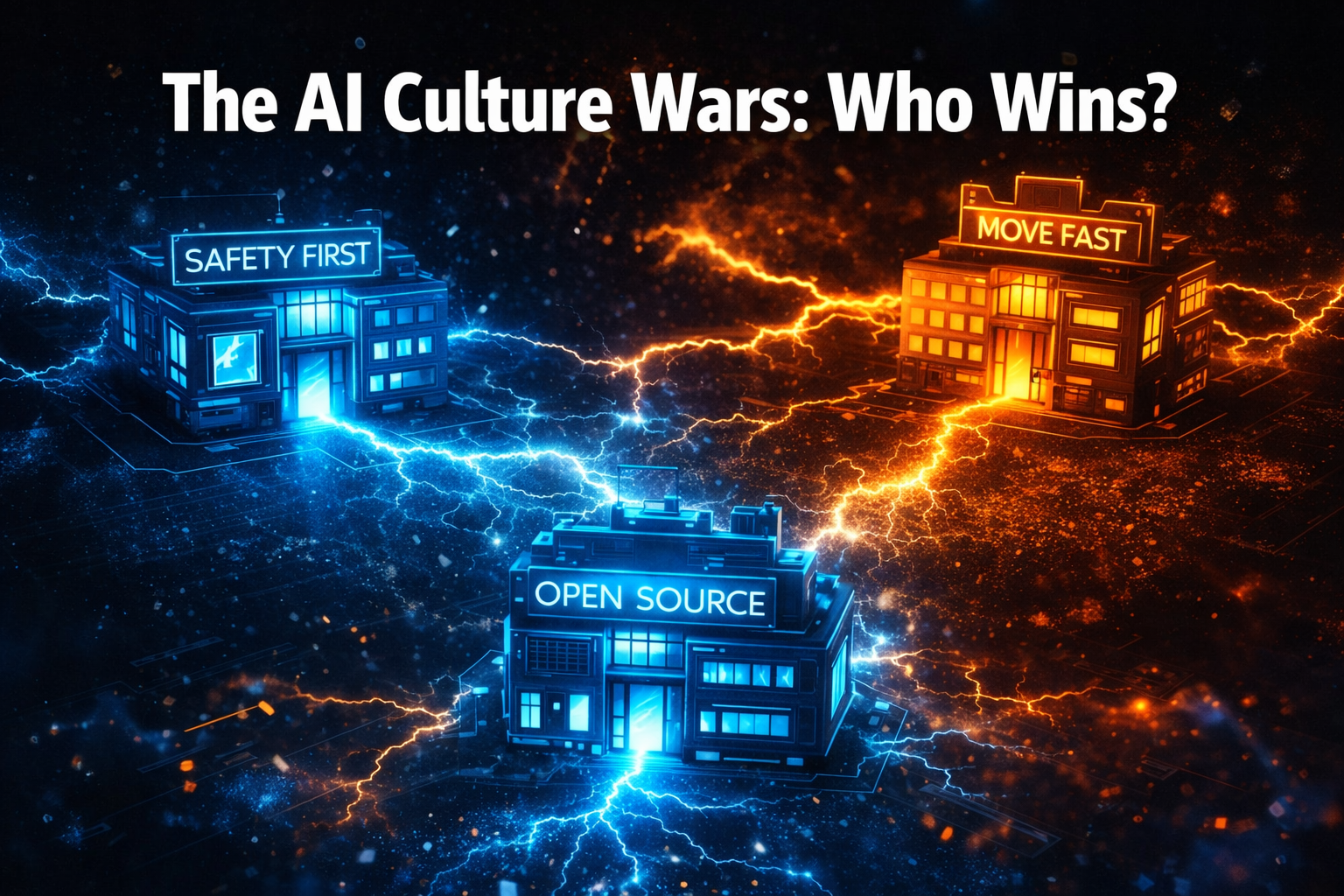
If you follow AI news closely enough, you have noticed that the disputes between the major AI labs and their communities go well beyond product competition. There are genuine philosophical, political, and cultural battles being fought simultaneously with the commercial race. Understanding these battles is essential context for interpreting almost everything that happens in AI: why certain safety policies exist, why talent moves between labs, why specific regulatory positions are taken, and why the language used by AI companies about their own products is sometimes strikingly different.
Thank you for reading this post, don't forget to subscribe!This is a guide to the AI culture wars: what the sides are, what they believe, where the conflicts come from, and why they matter for everyone who uses, builds, or is affected by AI systems.
Battle 1: Safety vs. Speed
The Safety Camp
The AI safety movement has roots in the effective altruism community and in the work of researchers who, as early as the 2010s, were publishing serious arguments that sufficiently advanced AI systems could pose existential risks to humanity if their goals and values were not carefully aligned with human interests. Anthropic was founded by former OpenAI researchers who left over disagreements about safety culture and the pace of capability development relative to safety research.
The safety camp broadly believes that the development of AI systems more capable than humans in general domains requires solving alignment problems that have not yet been solved, and that the race to build and deploy more capable systems before those alignment problems are addressed creates risks that outweigh the near-term benefits. This position ranges from cautious incrementalism to explicit calls for development pauses or international coordination on capability limits.
The Acceleration Camp
On the other side, a vocal community of AI researchers, investors, and builders argues that the risks emphasized by the safety movement are speculative and distant while the benefits of AI, in medicine, scientific research, economic productivity, and human capability augmentation, are immediate and certain. Delaying AI development to address speculative future risks imposes real present costs that are rarely acknowledged in the safety debate.
The most articulate version of this position, associated with thinkers like Marc Andreessen and the effective accelerationism movement, argues that AI capability development should proceed as fast as possible because the benefits compound and the risks, to the extent they exist, are best addressed by building more capable and more aligned systems rather than by slowing development.
The Core Tension: Both sides agree that AI is transformative. They disagree about whether the primary risk of AI is developing it too slowly (missing the benefits, falling behind geopolitically) or developing it too quickly (deploying systems that cause harm before we understand how to align them). This disagreement cannot be resolved by data alone because it involves predictions about future capabilities that neither side can verify.
Battle 2: The Effective Altruism Identity Crisis
The effective altruism movement played a significant role in the founding of several major AI safety organizations and labs, including Anthropic and the Machine Intelligence Research Institute. The movement’s philosophical framework, rigorously prioritizing actions that produce the most good across all possible future people, led many of its members to conclude that AI alignment was the most important problem in the world.
The collapse of FTX and Sam Bankman-Fried’s conviction created a credibility crisis for EA-adjacent communities that had been associated with him and his philanthropy. This crisis intersected with the AI safety community at a difficult moment, as the same philosophical framework that had produced serious AI safety research had also produced the catastrophically mistaken utilitarian reasoning that apparently justified fraud.
The fallout has created fractures within the AI safety community about whether EA-style reasoning is a reliable guide to AI governance and whether the movement’s association with both AI safety and the FTX collapse has damaged the credibility of safety arguments in public policy contexts.
Battle 3: OpenAI’s Internal Civil War
OpenAI’s November 2023 board crisis, in which CEO Sam Altman was briefly fired and then reinstated after an employee revolt and investor pressure, was the most publicly visible expression of a culture war that had been developing inside the organization for years. The board that fired Altman was composed primarily of people with AI safety backgrounds who believed the company was moving too fast without sufficient safety oversight. The investors and employees who demanded Altman’s reinstatement represented the commercial and capability-focused vision of OpenAI’s direction.
Altman’s reinstatement and the subsequent board restructuring represented a decisive, if not permanent, victory for the commercial vision over the safety governance structure. The researchers who had been most closely associated with the safety-first board have largely departed, and OpenAI has accelerated its commercial partnerships, including the DoD relationship, in ways that directly contradict the organizational commitments that motivated the board’s original action.
The Non-Profit to For-Profit Conversion
OpenAI’s transition from a capped-profit structure to a full for-profit corporation is the organizational expression of this culture war outcome. The original non-profit structure was designed to ensure that the company’s mission, developing AI for the benefit of humanity, would not be compromised by investor return requirements. The conversion to for-profit status removes that structural protection, which the safety-oriented founders viewed as essential and the commercial-oriented investors viewed as an unnecessary constraint.
Battle 4: The Dario vs. Sam Proxy War
The public rivalry between Anthropic CEO Dario Amodei and OpenAI CEO Sam Altman has become a proxy for the broader culture war between safety-first and capability-first AI development. Their public disagreements, over military partnerships, over safety claims in product marketing, over the appropriate role of AI in government, and over the credibility of each other’s stated commitments, play out in media coverage and investor conversations in ways that influence how the entire industry is perceived.
Amodei’s positioning of Anthropic as the responsible alternative to OpenAI’s faster-moving culture is both genuine philosophical conviction and commercial strategy. The AI safety brand is valuable for certain enterprise customers, government relationships, and talent recruitment. Whether Anthropic’s actual safety practices are meaningfully different from OpenAI’s, or whether the difference is primarily in emphasis and communication, is a question that neither company’s external disclosures fully answer.
Battle 5: Centralized vs. Open AI
A fifth front in the AI culture wars is the debate between centralized AI development at large labs versus open-source AI development that distributes model capabilities broadly. Meta’s release of the Llama model family as open weights has been the most consequential intervention in this debate, providing frontier-class capabilities to any developer who wants them without requiring access to proprietary APIs.
The safety camp tends to oppose open-weight model releases on the grounds that capabilities, once released, cannot be recalled, and that powerful models in the hands of malicious actors create risks that outweigh the benefits of democratized access. The open-source camp argues that concentration of AI capabilities in a few large labs creates its own risks: monopolistic behavior, lack of external scrutiny of alignment claims, and exclusion of the global research community from the work that will shape the future.
Why This Culture War Matters for Everyone
The outcome of these debates is not purely academic. The positions taken in the AI culture wars directly influence which safety standards get adopted, which government regulations get proposed and passed, how much transparency AI labs provide about their research and systems, and how talent and capital flow through the industry.
The lab that wins the commercial AI race will have enormous influence over how AI development proceeds globally. Whether that winning lab has a safety-oriented or capability-oriented culture will shape the risks and benefits that AI creates for society in ways that extend far beyond any individual product or policy decision.
Bottom Line: The AI culture wars are not a distraction from the real work of building AI. They are a fight over the values that will be embedded in the most powerful technology in human history. Understanding where the sides are and what they believe is essential context for anyone trying to make sense of AI news, AI policy, or AI’s trajectory.
Related: Anthropic Pentagon Blacklist | ChatGPT DoD Deal Uninstalls | Why Top AI Talent Is Leaving
Related Posts

Stay Informed With the Latest & Most Important News



Top News
- Google’s AI-Powered Workspace in Search Is Now Available to All US Users: Here Is What Actually Changed

- How Jeffrey Epstein Used Silicon Valley’s Network: What the Reporting on Reid Hoffman and Tech’s Elite Reveals
- Where to Preorder the iPhone 17E Right Now: Every Deal Ranked Before the March 11 Launch

- Google Apps Experience and Games Level Up: The Programs That Could Cut Your Play Store Commission Significantly

- Google Is Not Waiting for a Settlement: It Just Killed the 30 Percent App Store Fee Unilaterally












Advertisement