

Now Reading: Raycast Glaze Is the All-in-One Vibe Coding Platform You Have Been Waiting For: Full Review
-
01
Raycast Glaze Is the All-in-One Vibe Coding Platform You Have Been Waiting For: Full Review
Raycast Glaze Is the All-in-One Vibe Coding Platform You Have Been Waiting For: Full Review

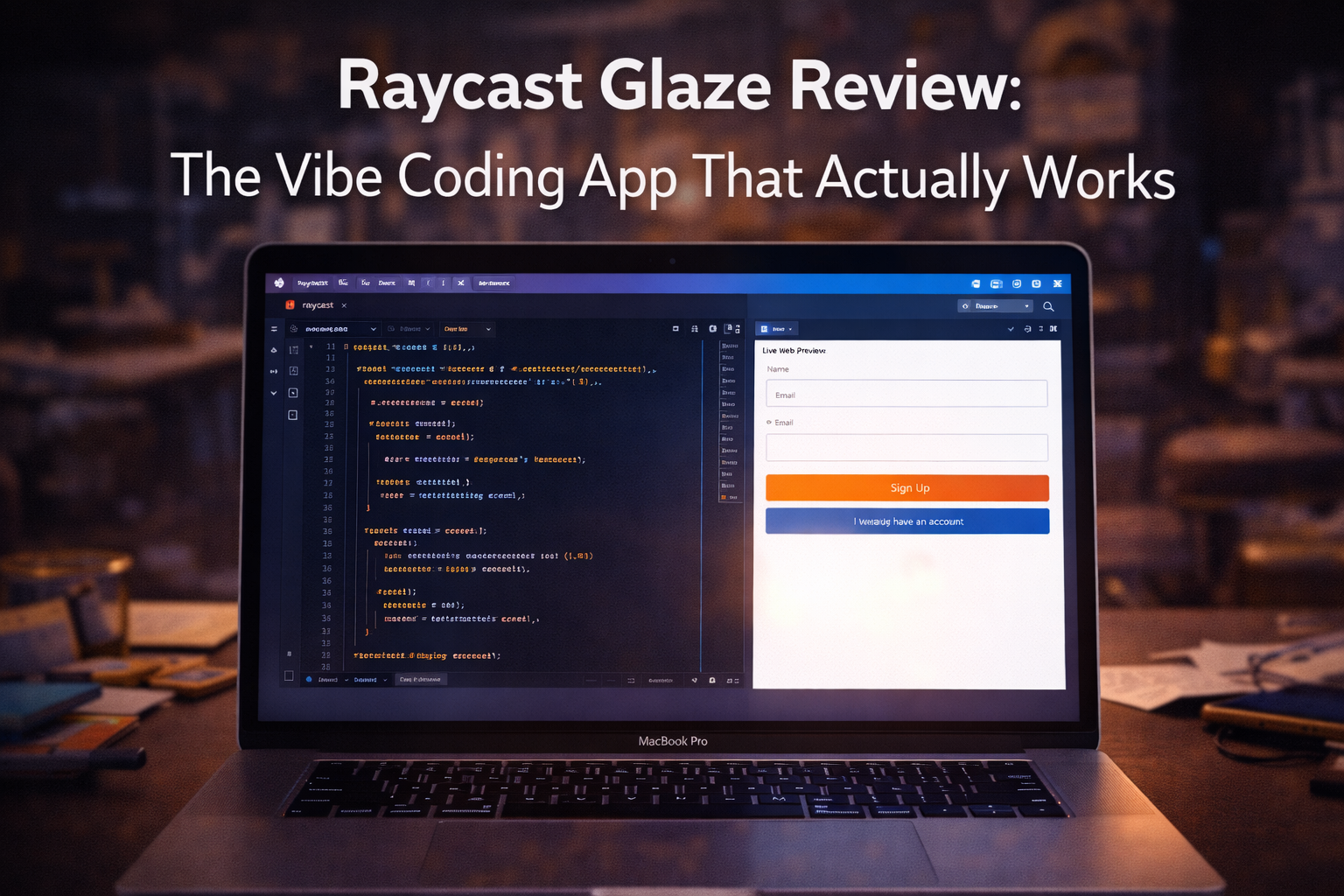
Vibe coding is real. The practice of building functional software primarily through natural language interaction with AI, describing what you want the code to do rather than writing it line by line, has moved from novelty to legitimate development approach fast enough that a new category of tooling has emerged specifically to support it.
Thank you for reading this post, don't forget to subscribe!Raycast, the productivity platform that has become a cult favorite among Mac developers and power users, has entered this space with Glaze: an all-in-one platform that combines AI-assisted code generation, project management, deployment tooling, and the kind of highly configurable interface that Raycast’s existing users already know and trust. After extensive time with it, here is the full picture.
What Is Vibe Coding and Why Does It Need a Dedicated Platform?
Vibe coding describes the workflow of using AI to generate the majority of code in a project while the developer’s primary role shifts from writing syntax to directing, reviewing, and integrating AI-generated output. The term captures both the legitimacy of this approach as a real development workflow and the distinct way of thinking it requires: less time on implementation details, more time on architecture, requirements, and quality review.
The existing tools for this workflow, primarily Cursor, GitHub Copilot, and direct Claude or ChatGPT API access, each handle part of the problem well but require developers to stitch together context, project management, deployment, and iteration manually. Glaze’s pitch is that it builds a coherent platform around the vibe coding workflow rather than adding AI features to existing tools that were not designed for it.
Raycast Glaze: The Core Features
Natural Language Project Creation
The entry point for Glaze is natural language project scaffolding. You describe the application you want to build, specify the technology stack if you have preferences, and Glaze generates a structured project with architecture decisions, file organization, and initial code that reflects your description. For standard project types, web apps, APIs, CLI tools, and mobile applications, the scaffolding quality is impressive.
The generated architecture is not just boilerplate. Glaze makes opinionated decisions about state management, component structure, data modeling, and testing setup that reflect the technology stack’s best practices. A developer reviewing the generated scaffold is reviewing real architectural choices rather than just syntactic noise.
Inline AI Assistance with Full Project Context
Unlike code completion tools that operate on the current file or function, Glaze maintains context across the entire project. When you ask it to implement a new feature, it understands the existing codebase architecture, the naming conventions already established, the data models in use, and the patterns that the project follows. The result is AI-generated code that actually fits the existing codebase rather than requiring significant adaptation.
This full-context awareness is the most technically impressive aspect of Glaze. Maintaining and querying against a full project context efficiently is a genuinely hard problem, and Glaze’s implementation is fast enough that it does not break the development flow that makes vibe coding productive.
The Context Difference: The gap between AI coding assistance with and without full project context is enormous. With full context, AI suggestions fit the existing codebase and require minimal editing. Without it, suggestions often conflict with existing patterns and require substantial rework. Glaze’s full-context architecture is its most important differentiator.
Integrated Deployment and Preview
Glaze integrates deployment workflows that let you preview and ship changes without leaving the platform. For web projects, this means instant preview deployments on every meaningful change, shareable links for stakeholder review, and one-click production deployment with sensible environment management defaults.
This integration matters for vibe coding specifically because the iteration cycle of describe, generate, review, deploy, describe again is where vibe coding’s productivity advantage is realized. Each manual step outside the platform breaks that cycle and reduces the cumulative time savings.
Raycast Integration: The Existing User Advantage
For existing Raycast users, Glaze benefits from deep integration with the Raycast platform: your extensions, scripts, integrations, and workflows are available within Glaze, and the keyboard-first, minimal-mouse interface philosophy that defines the Raycast experience carries through to the coding environment.
This integration gives Glaze a distribution advantage with Raycast’s existing user base and a quality-of-life advantage for developers who have already optimized their workflow around Raycast.
Glaze vs. Cursor: The Honest Comparison
Cursor is currently the market leader in AI-assisted coding environments, with a large and loyal user base, strong model integration, and active development. How does Glaze compare?
Project context: Glaze matches or exceeds Cursor on full-project-context AI assistance, which is the most important dimension.
Model selection: Cursor offers more granular model selection and configuration. Glaze’s model choices are currently more opinionated.
Deployment integration: Glaze’s integrated deployment is a significant advantage over Cursor, which requires external deployment tooling.
Ecosystem: Cursor has a larger established user community and more third-party resources. Glaze benefits from Raycast’s ecosystem.
Price: Both products have similar pricing structures at launch. Total cost depends on usage patterns and which features are most utilized.
Who Should Use Raycast Glaze
- Raycast users who want AI coding assistance integrated with their existing productivity workflow
- Indie developers and small teams building web applications who want to move fast without managing separate deployment infrastructure
- Developers exploring vibe coding who want a purpose-built environment rather than adapting existing IDEs
- Non-technical founders or product managers who want to prototype applications with AI assistance
Bottom Line: Raycast Glaze earns a strong recommendation for its target audience, particularly Raycast users and developers committed to AI-first development workflows. The full-project-context AI assistance and integrated deployment are genuinely valuable differentiators. It is not a Cursor replacement for every developer, but for the vibe coding workflow specifically, it is the most coherent platform currently available. Score: 8.5/10
Related: Best AI Coding Tools 2025 | Claude Code: How Claude Codes | GitHub Copilot vs Cursor vs Glaze
Related Posts

Stay Informed With the Latest & Most Important News


Top News
- Google’s AI-Powered Workspace in Search Is Now Available to All US Users: Here Is What Actually Changed

- How Jeffrey Epstein Used Silicon Valley’s Network: What the Reporting on Reid Hoffman and Tech’s Elite Reveals

- Where to Preorder the iPhone 17E Right Now: Every Deal Ranked Before the March 11 Launch

- Google Apps Experience and Games Level Up: The Programs That Could Cut Your Play Store Commission Significantly

- Google Is Not Waiting for a Settlement: It Just Killed the 30 Percent App Store Fee Unilaterally














Advertisement