
Now Reading: Investors Are Now Openly Telling You What They Do Not Want in AI SaaS: Here Is the Full List
-
01
Investors Are Now Openly Telling You What They Do Not Want in AI SaaS: Here Is the Full List
Investors Are Now Openly Telling You What They Do Not Want in AI SaaS: Here Is the Full List

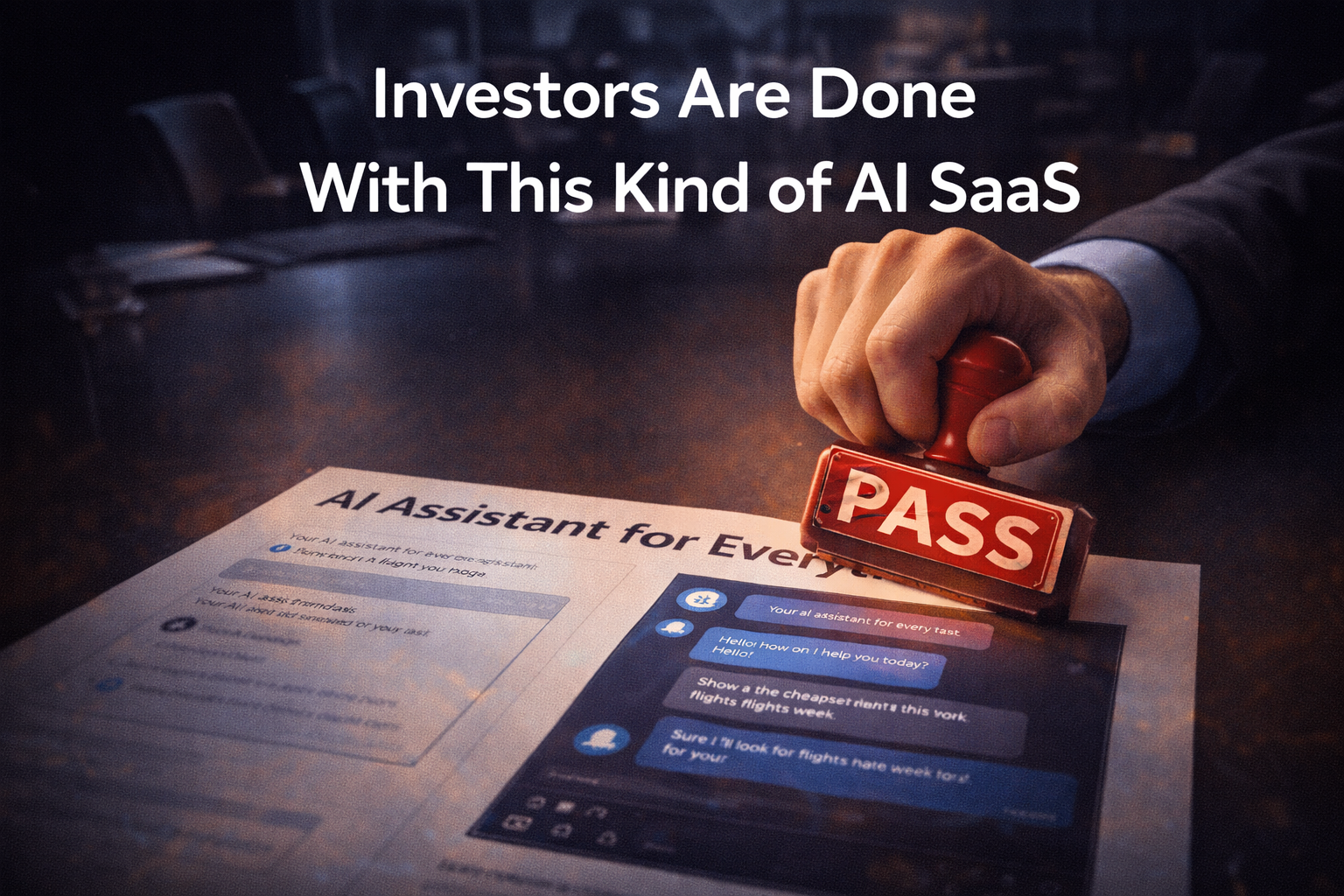
There is a period in every technology wave when investors become willing to fund almost anything with the right buzzwords attached. The early AI wave had this quality in 2022 and 2023. A well-designed deck, a credible founding team, and a plausible story about how AI would transform a specific industry was frequently sufficient to raise a seed or Series A round at favorable terms.
Thank you for reading this post, don't forget to subscribe!That period is over. Sophisticated AI investors are now not only more selective but are also more willing to articulate exactly what they are avoiding. The candid disclosures about what investors no longer want to fund in AI SaaS are among the most useful signals available to founders building in this space.
The Red Flags That Are Killing Deals in 2025
Thin Wrappers Around Foundation Model APIs
The most frequently cited dealbreaker across AI investor conversations is the thin wrapper: a product that adds a user interface and a specific workflow context on top of a foundation model API without any proprietary data, model customization, or genuine workflow integration that creates switching costs.
The concern is straightforward. If an AI SaaS product’s primary capability is prompting GPT-4o or Claude effectively and presenting the results in a specific interface, that capability will be commoditized within months as foundation model providers improve their interfaces, reduce API costs, and build competing products themselves. There is no durable business in being the translation layer between a foundation model and an end user.
The Wrapper Test: Investors are applying a simple test: if OpenAI, Anthropic, or Google built this product as a feature of their existing platform, would the AI SaaS company survive? If the answer is no, the product is a wrapper and the investment thesis fails.
No Proprietary Data Advantage
Closely related to the wrapper problem is the data problem. AI products built on foundation models are, by default, working with the same underlying capabilities as every other product built on the same foundation model. The only reliable differentiation comes from proprietary data that makes the AI more accurate, more useful, or more personalized in a specific domain than a generic deployment.
Investors are scrutinizing data moats with a level of rigor that was rare two years ago. Questions about data provenance, exclusivity, volume, quality, and the mechanism by which the product generates better data over time are now standard due diligence items that founders must answer credibly.
Generic Horizontal AI Assistants
The market for general-purpose AI productivity assistants is now effectively owned by Microsoft Copilot, Google Gemini, and ChatGPT Enterprise. These products have distribution advantages, trust advantages, and integration advantages that independent horizontal AI assistants cannot overcome at a reasonable cost of customer acquisition.
Investors are avoiding new pitches for general-purpose AI writing assistants, meeting summarizers, email helpers, and productivity tools that compete head-on with these entrenched platforms without a clear and credible answer to the distribution and trust gap.
Sales-Led Growth Without Product-Led Signals
AI SaaS companies that rely entirely on enterprise sales cycles to acquire customers, with no organic product-led growth, individual user adoption, or bottom-up enterprise penetration, are raising questions about true product-market fit. If the product only works when a salesperson is actively managing the relationship, the underlying value proposition may be weaker than the revenue suggests.
Investors are looking for evidence that users actively seek out the product, return voluntarily, expand their usage without sales pressure, and talk about it positively with colleagues. These signals are harder to manufacture than a signed enterprise contract and are therefore more trustworthy as indicators of genuine value creation.
Regulatory Risk Without a Mitigation Plan
AI products in regulated industries, healthcare, finance, legal, education, government, face regulatory headwinds that investors are now pricing carefully. A compelling AI product that cannot operate in a regulated environment without significant compliance investment is a more complicated investment than it looks.
Investors are not avoiding regulated industries categorically. They are avoiding companies that do not have clear, credible answers to regulatory risk including HIPAA compliance for health AI, SOC 2 and GDPR for enterprise data handling, financial services regulations for fintech AI, and the emerging AI-specific regulatory requirements in the EU and increasingly in the US.
What Investors Are Still Actively Seeking
- Vertical AI with deep workflow integration: Products that go beyond surface-level AI capability to become the operating system for a specific professional workflow
- Network effect AI: Products where each new user makes the product better for all users through collective training data or community-generated content
- AI-enabled services businesses: Companies that use AI to deliver services at margins impossible for human-only service providers
- Infrastructure and developer tools: Products that other AI companies need to build and operate their own AI products
- AI that replaces significant headcount in a measurable way: Products with clear, quantifiable labor cost reduction that makes the ROI calculation obvious
The Funding Climate Shift
The shift in investor criteria reflects a maturation of the market rather than a loss of enthusiasm for AI. The investors who are most vocal about what they are avoiding are also among the most active deployers of capital into AI. Their selectivity is about finding the businesses with genuine durability rather than abandoning the AI investment thesis.
For founders, the message is clear: the bar has moved. Building a compelling AI product in 2025 requires demonstrating genuine differentiation, defensible data or workflow position, and a clear theory of why the business survives as the underlying foundation models continue to improve and the platform providers continue to build competing features.
Bottom Line: The investors who are openly sharing what they are avoiding in AI SaaS are doing founders a favor. The criteria they have articulated, proprietary data, genuine workflow integration, switching costs, and defensibility against platform encroachment, are the correct criteria for building a durable AI business. Founders who internalize these criteria before they pitch will build better companies.
Related: AI Startup Equity at Two Prices | Behavioral AI and Compatibility Advantage | A16z $1.7B AI Infrastructure Fund
Stay Informed With the Latest & Most Important News


Top News
- Google’s AI-Powered Workspace in Search Is Now Available to All US Users: Here Is What Actually Changed

- How Jeffrey Epstein Used Silicon Valley’s Network: What the Reporting on Reid Hoffman and Tech’s Elite Reveals
- Where to Preorder the iPhone 17E Right Now: Every Deal Ranked Before the March 11 Launch

- Google Apps Experience and Games Level Up: The Programs That Could Cut Your Play Store Commission Significantly

- Google Is Not Waiting for a Settlement: It Just Killed the 30 Percent App Store Fee Unilaterally













Advertisement