

Now Reading: Inside the Secret Meeting That Launched the AI Political Resistance: What Happened and What Comes Next
-
01
Inside the Secret Meeting That Launched the AI Political Resistance: What Happened and What Comes Next
Inside the Secret Meeting That Launched the AI Political Resistance: What Happened and What Comes Next

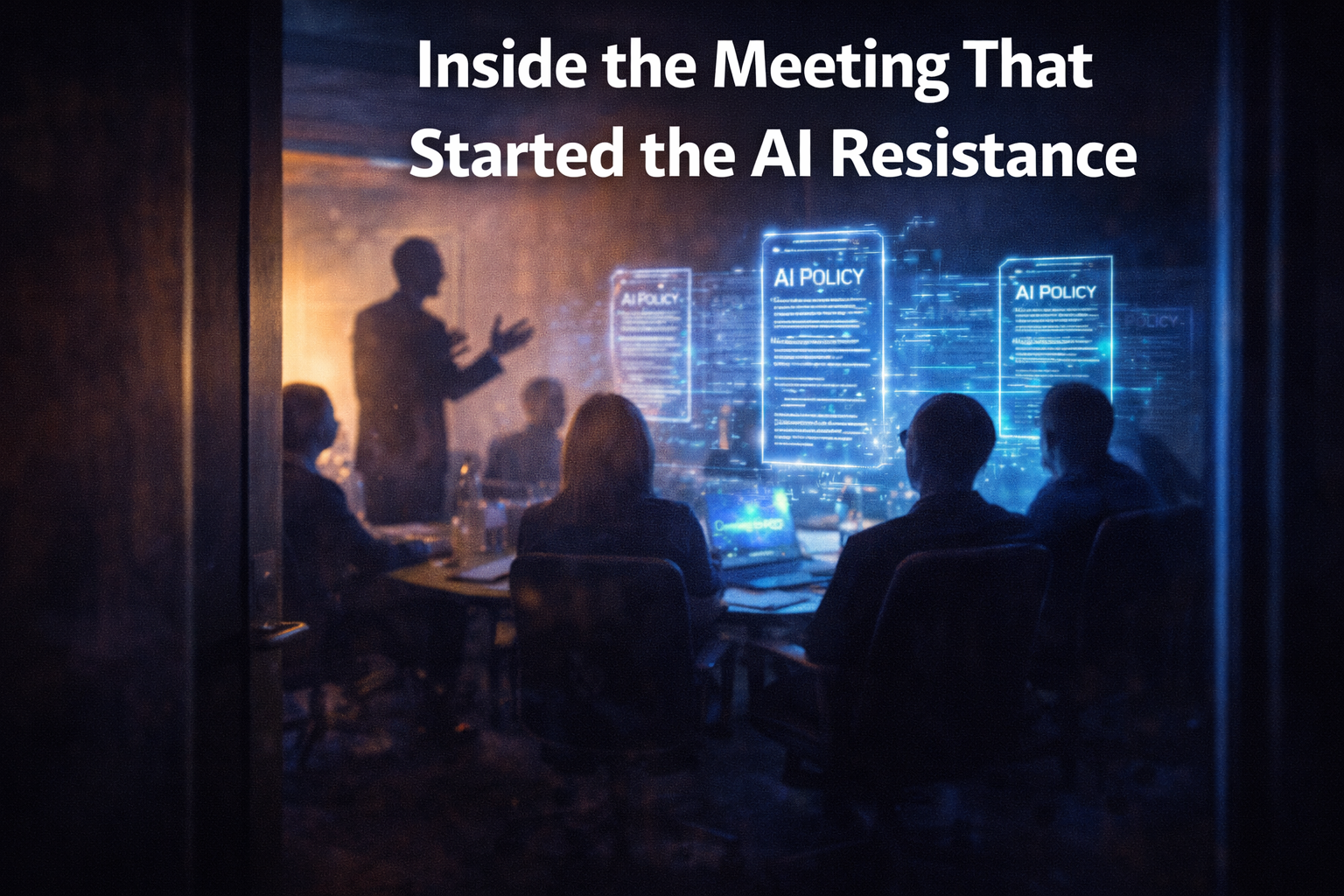
The dominant narrative about technology and politics in 2025 has been about tech industry power consolidating around government: AI labs signing Pentagon contracts, tech billionaires taking government advisory roles, regulatory oversight agencies being scaled back. The resistance to this narrative has been quieter, less funded, and organized through channels that deliberately avoided the kind of attention that invites retaliation.
Thank you for reading this post, don't forget to subscribe!Reports have now surfaced about a gathering of AI researchers, policy advocates, ethicists, and civil society representatives that took place in the weeks following the most consequential shifts in AI governance, and which produced the organizational foundation for a coordinated resistance movement that is still developing. Here is what is known about what happened, who was involved, and what the movement is attempting to accomplish.
The Precipitating Events
The meeting was preceded by a sequence of AI governance developments that each, individually, had generated concern among the AI safety and ethics community, but which in combination created a sense of crisis among researchers who had spent years working on AI policy frameworks. The dismantling of responsible AI oversight offices at major technology companies, the normalization of military AI applications without the ethical review processes those applications had previously required, and the explicit rollback of regulatory frameworks that had been years in development created a compressed timeline of change that participants described as requiring an organized response.
Critically, many of the people at the meeting had been working within institutions, as researchers at AI labs, as policy advisors to government agencies, as academic consultants on AI governance frameworks, that were now moving in directions they found incompatible with their professional and ethical commitments. The meeting was partly about what to do with that position: whether to remain inside institutions and try to influence them, or to build external pressure capacity that could operate independently.
The Institutional vs. External Dilemma: AI researchers with institutional access can potentially moderate the direction of powerful organizations from within. But institutional access comes with constraints on what can be said publicly, and organizations moving quickly in problematic directions may not slow for internal objection. The resistance movement is partly a response to researchers concluding that external pressure is necessary because internal advocacy has reached its limits.
Who Was at the Meeting
Participants included researchers who had left or been pushed out of major AI labs following governance disputes, policy advocates from civil liberties and technology accountability organizations, academic computer scientists whose work focuses on AI safety and alignment, journalists covering the AI governance beat, and foundation program officers whose grant-making in the AI safety space gives them visibility into the landscape of organizations working in this area.
The deliberate absence of currently employed researchers at major AI labs was noted by participants. The concern was that attendance by active lab employees could create professional consequences for them and might be used to characterize the meeting as a coordinated effort by lab insiders, which participants wanted to avoid. The movement is explicitly positioning itself as external to the major labs rather than as a faction within them.
What Was Agreed
The meeting produced a set of working commitments rather than a formal organizational structure. Participants agreed on several immediate priorities: building a rapid response capacity to publicly analyze and contextualize AI governance decisions as they occur, establishing communication channels that allow coordination without the surveillance risk that public social media coordination creates, and developing a framework for evaluating which AI governance rollbacks are most consequential and therefore warrant the most concentrated response effort.
A longer-term objective discussed was the creation of an independent technical body capable of producing credible assessments of AI safety claims made by labs and government agencies, providing a counterpoint to the self-assessments that AI companies currently offer as the primary evidence of their safety practices.
The Movement’s Theory of Change
The political theory underlying the resistance movement is that the current AI governance direction is vulnerable to public accountability pressure in ways that purely technical or insider advocacy is not. The movement’s bet is that sustained, credible, technically grounded public criticism of specific AI governance decisions, made by people with genuine expertise and no financial stake in the outcome, can shift the policy environment even without direct institutional access.
This theory has precedents in other technology policy domains. The effective advocacy against specific surveillance technology deployments, for example, has frequently come from external civil society pressure rather than institutional reform. The AI governance domain is different in important ways, including the speed of development and the concentration of expertise within the companies being scrutinized, but the basic mechanism of external accountability pressure is applicable.
What They Are Up Against
The resistance movement faces structural disadvantages that its participants are clear-eyed about. The organizations it is pushing back against have orders of magnitude more resources, access to government decision-makers, and the ability to move faster than a decentralized advocacy network. The researchers and advocates involved typically do not have the financial resources to sustain full-time resistance work without institutional support, which creates dependency on foundations and donors who have their own strategic interests.
The movement also faces a credibility challenge: the most technically qualified people to evaluate AI safety and governance are typically employed by AI labs, and their employment creates conflicts of interest that reduce the credibility of their public statements. Independent expertise in frontier AI is genuinely scarce, and building independent technical credibility is a multi-year project.
Bottom Line: The AI political resistance is real, organized, and operating with a clearer strategic framework than its low public profile suggests. Whether it can accumulate the credibility, resources, and public attention necessary to influence AI governance in a meaningful way is uncertain. The fact that it is being built by people with genuine technical expertise and clear-eyed strategic thinking gives it more potential than most resistance movements operating with comparable resources.
Related: AI Culture Wars Explained | Why Top Talent Is Leaving OpenAI and xAI | Anthropic Pentagon Blacklist
Related Posts



Stay Informed With the Latest & Most Important News



Top News
- Google’s AI-Powered Workspace in Search Is Now Available to All US Users: Here Is What Actually Changed

- How Jeffrey Epstein Used Silicon Valley’s Network: What the Reporting on Reid Hoffman and Tech’s Elite Reveals
- Where to Preorder the iPhone 17E Right Now: Every Deal Ranked Before the March 11 Launch

- Google Apps Experience and Games Level Up: The Programs That Could Cut Your Play Store Commission Significantly

- Google Is Not Waiting for a Settlement: It Just Killed the 30 Percent App Store Fee Unilaterally













Advertisement