

Now Reading: India’s Creator Economy and AI Ambitions Are on a Collision Course: Here Is What Happens Next
-
01
India’s Creator Economy and AI Ambitions Are on a Collision Course: Here Is What Happens Next
India’s Creator Economy and AI Ambitions Are on a Collision Course: Here Is What Happens Next

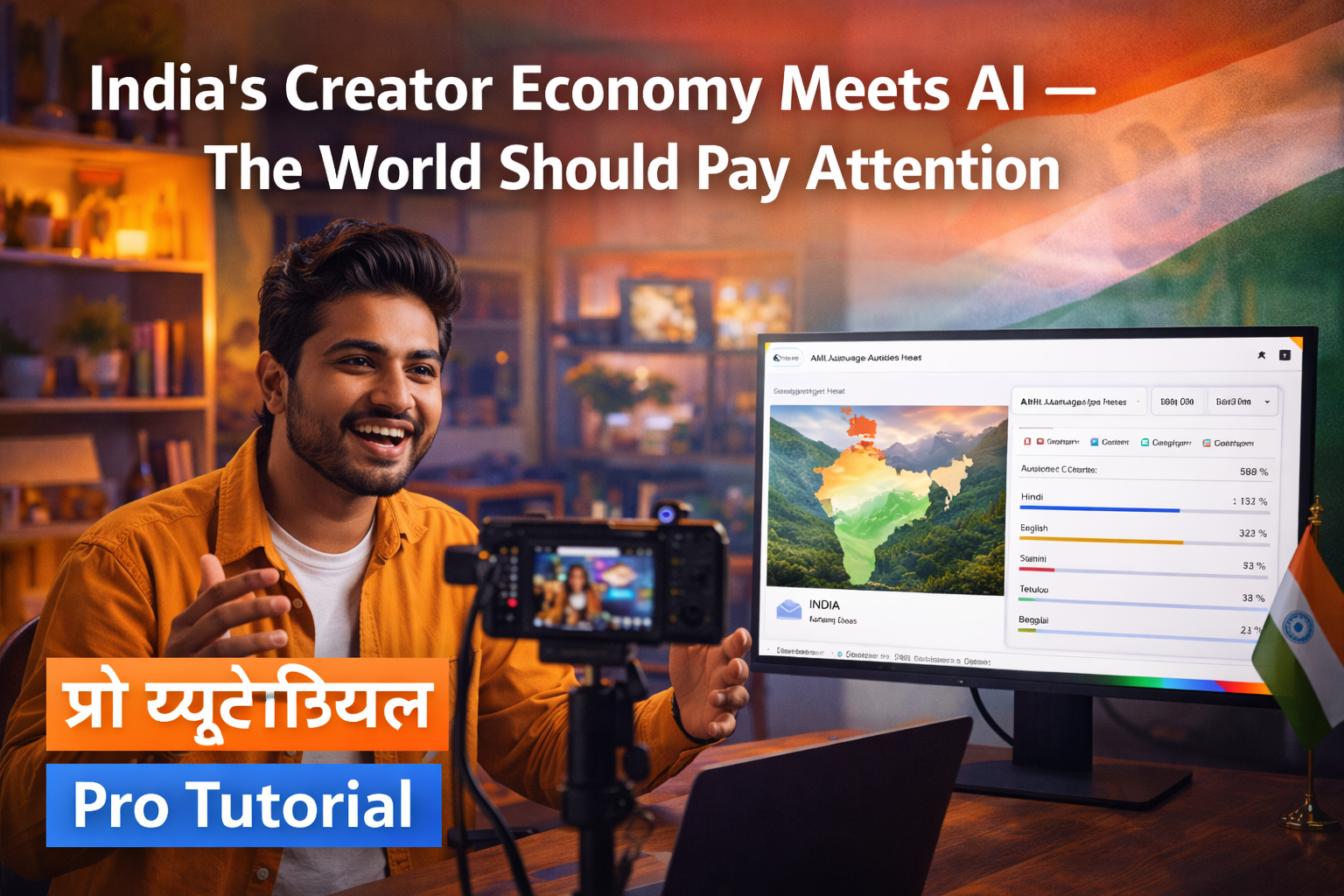
Two of the most consequential trends in global technology are happening simultaneously in India at a scale that their individual components do not fully capture. India has the largest creator economy by number of creators in the world, with over 100 million people creating content for digital platforms. India has also launched the most ambitious national AI development program outside the United States and China, including significant government investment in compute infrastructure, AI research institutions, and regulatory frameworks for AI deployment.
Thank you for reading this post, don't forget to subscribe!The convergence of these two trends is creating dynamics that will influence both the global creator economy and the global AI governance conversation for years to come.
The Scale of India’s Creator Economy
India’s creator economy is not just large in absolute numbers. It is structurally distinctive in ways that matter for how AI will interact with it. Indian creators operate across a language diversity that has no parallel anywhere else: major content communities exist in Hindi, Tamil, Telugu, Bengali, Kannada, Malayalam, Marathi, and dozens of other languages, each with large, distinct audiences that do not neatly overlap.
This linguistic diversity creates both an opportunity and a challenge for AI. The opportunity is that AI-powered translation, dubbing, and localization tools can help Indian creators reach audiences across language barriers that previously required separate content production. The challenge is that AI systems trained primarily on English-language internet content perform significantly worse in Indian languages, which creates quality gaps that disadvantage the world’s largest creator population.
The Platform Concentration Problem
India’s creator economy is concentrated on a small number of global platforms, primarily YouTube, Instagram, and ShareChat, that capture most of the advertising revenue generated by Indian creator content. The revenue capture dynamics that disadvantage creators globally are particularly acute in India, where advertising rates (CPMs) are lower than in Western markets even for equivalent engagement levels, meaning Indian creators generating the same views as American creators earn significantly less.
This revenue gap is a source of sustained friction between Indian creators and the global platforms, and it is one of the factors driving Indian government interest in supporting domestic platform alternatives and in negotiating better terms for Indian content within global platform advertising systems.
The CPM Gap: A YouTube creator in the United States might earn $3 to $8 per thousand views in advertising revenue. The same creator with the same content in India earns $0.20 to $0.80 per thousand views. This 10x to 20x gap in advertising revenue rates is structural to global digital advertising markets and represents a significant economic disadvantage for Indian creators at global scale.
India’s National AI Program
The Indian government’s AI mission is one of the most substantial national AI programs currently operational outside the US and China. The program includes government-funded compute infrastructure to reduce dependence on US hyperscalers for AI training, investment in Indian-language AI model development, AI application programs in agriculture, healthcare, and education targeting India’s scale challenges, and a regulatory framework that is evolving toward requiring AI transparency and accountability.
The compute infrastructure investment is particularly significant. India has historically been dependent on US cloud providers, primarily AWS, Google Cloud, and Azure, for the compute needed to train AI models at scale. Building domestic compute infrastructure is both a strategic independence play and a practical prerequisite for developing AI models specifically optimized for Indian languages and use cases.
India-Specific AI Models
Several major AI model development programs focused on Indian languages are now operational. Sarvam AI, a Bangalore-based startup, has developed language models specifically trained on Indian language data with performance significantly better than multilingual models in Hindi, Tamil, and other major Indian languages. Government-backed research institutions are developing comparable programs.
For the creator economy, Indian-language AI models enable applications that global models cannot serve well: real-time translation between Indian languages for cross-regional content distribution, AI dubbing that preserves emotional resonance in local languages, regional dialect understanding for content moderation and recommendation systems, and AI-assisted content creation in languages where previous tools were inadequate.
The Regulatory Dimension
India’s Digital India Act and its draft AI regulation framework are being developed at a moment when the country has significant leverage as the world’s most populous nation and one of the largest digital advertising markets. India’s regulatory choices on AI will influence how global AI companies design their products for the world’s largest internet user base.
The specific questions being addressed in India’s AI regulation development include data localization requirements for AI training data, accountability frameworks for AI-generated content in politically sensitive contexts, platform obligations for AI content recommendation transparency, and creator rights frameworks that address the use of creator content for AI training.
The Global Implications
India’s combination of creator economy scale and AI ambition is significant for the global conversation because it represents a major non-Western voice in both discussions. The creator rights frameworks being developed in India, the Indian-language AI models being built, and the regulatory standards being negotiated will all influence global standards in ways that a smaller economy could not.
For global AI companies, India’s market is too large to design around. A regulatory requirement or technical standard that India adopts, whether for AI transparency, creator rights, or language model performance, creates pressure for global compliance that extends the Indian standard’s reach far beyond its borders.
- YouTube, Meta, and TikTok are all investing specifically in Indian-language AI improvements in direct response to Indian market pressure
- Indian AI regulatory frameworks are being watched closely by the EU and other jurisdictions developing their own approaches
- Indian creator rights advocacy organizations are coordinating with international counterparts to build shared positions on AI training data compensation
Bottom Line: The convergence of India’s creator economy scale and its AI ambition is one of the most important technology stories in the world right now. The outcomes of India’s AI governance decisions, its language model investments, and its creator rights frameworks will shape global AI development in ways that the global technology conversation frequently underestimates.
Related: Instagram TikTok Using Your Content for Ads | AI Culture Wars | Post-Hype Crypto Market 2025
Related Posts



Stay Informed With the Latest & Most Important News

Top News
- Google’s AI-Powered Workspace in Search Is Now Available to All US Users: Here Is What Actually Changed

- How Jeffrey Epstein Used Silicon Valley’s Network: What the Reporting on Reid Hoffman and Tech’s Elite Reveals

- Where to Preorder the iPhone 17E Right Now: Every Deal Ranked Before the March 11 Launch

- Google Apps Experience and Games Level Up: The Programs That Could Cut Your Play Store Commission Significantly

- Google Is Not Waiting for a Settlement: It Just Killed the 30 Percent App Store Fee Unilaterally














Advertisement