

Now Reading: How PopSockets Broke Every Rule of VC-Backed Consumer Hardware and Built a Billion-Dollar Company Anyway
-
01
How PopSockets Broke Every Rule of VC-Backed Consumer Hardware and Built a Billion-Dollar Company Anyway
How PopSockets Broke Every Rule of VC-Backed Consumer Hardware and Built a Billion-Dollar Company Anyway

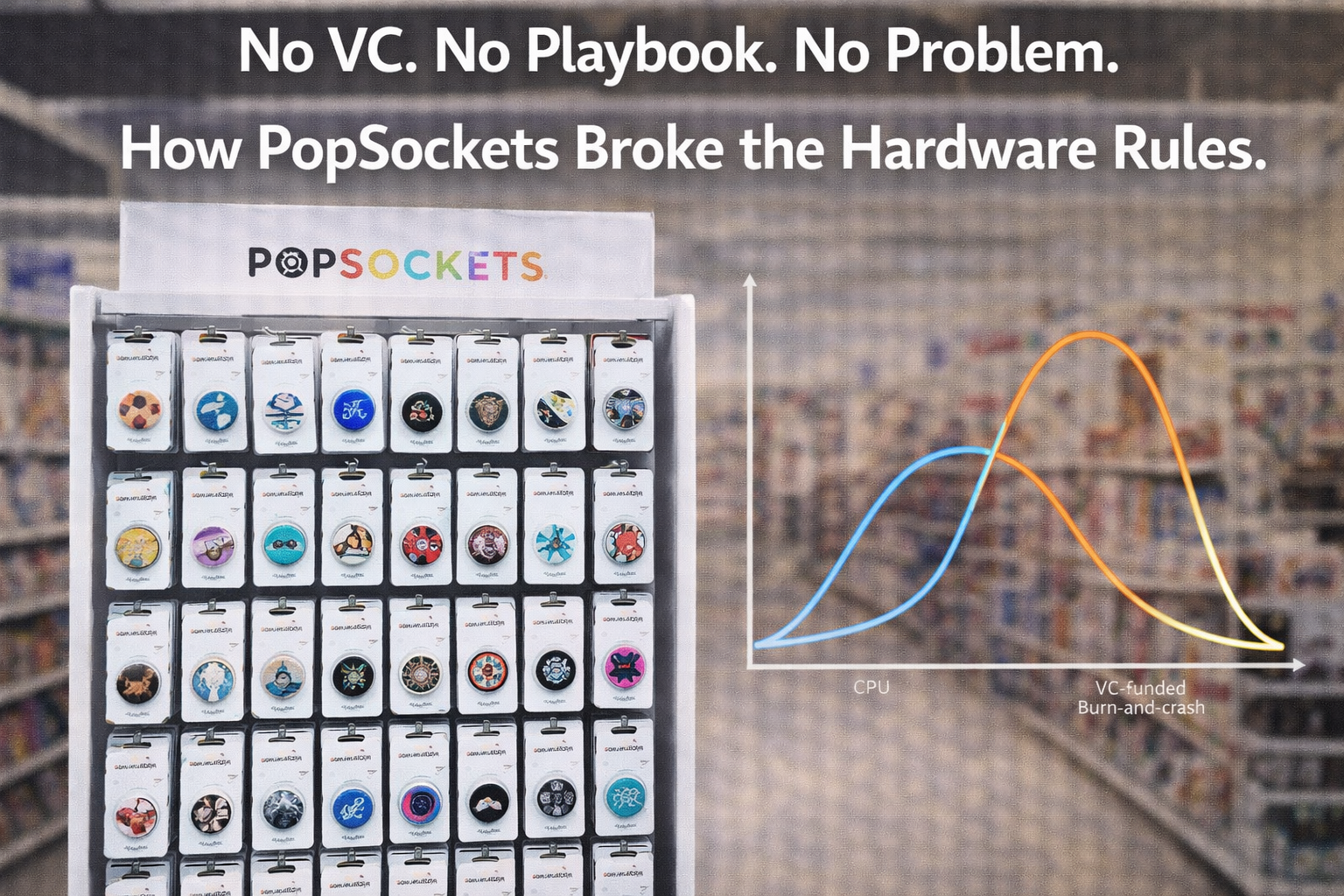
Consumer hardware startups have a well-documented failure pattern. They raise venture capital at optimistic valuations, spend it on product development and marketing at unsustainable rates, discover that hardware margins are too thin to support the growth trajectory investors require, and either pivot, dilute massively, or shut down. The graveyard of VC-backed consumer hardware companies is extensive and well-documented.
Thank you for reading this post, don't forget to subscribe!PopSockets is not in that graveyard. The company that David Barnett built without conventional venture capital, through craft fairs and Amazon, on the back of a product that most VCs would have dismissed as too simple to defend, became one of the most commercially successful consumer accessories companies of the smartphone era. Understanding how it broke the mold is more useful than cataloging the companies that followed the mold and failed.
The VC Hardware Playbook and Why PopSockets Ignored It
What the Playbook Says
The standard VC consumer hardware playbook runs roughly like this: identify a large addressable market, design a product that captures a meaningful share of it, raise capital to fund manufacturing and inventory, spend heavily on digital customer acquisition to reach the target customer before competitors can, build brand awareness at scale, and either achieve the revenue required to justify a Series B or exit to a strategic acquirer before the capital runs out.
This playbook has produced some successful companies. It has more frequently produced companies that are capital-efficient at losing money: they successfully acquire customers, they successfully manufacture products, and they successfully fail to generate the margins and retention rates required to make the unit economics work at scale.
What PopSockets Did Instead
Barnett’s approach inverted nearly every assumption of the standard playbook. Customer acquisition came from organic discovery at craft fairs and on Etsy, where word-of-mouth and platform search drove customers to the product without paid acquisition costs. Manufacturing was scaled gradually as demand demonstrated itself, rather than ahead of demand based on projections.
The product’s single, focused function, gripping and standing a phone, was not the kind of technical complexity that attracts venture capital attention. Investors looking for defensible IP, complex manufacturing processes, or software moats would not find them in a small accordion of plastic and adhesive. What they would miss is the defensibility that comes from owning a physical space, literally the back of every smartphone, and the lifestyle identity that PopSockets created around that space.
The Physical Space Moat: PopSockets’ most defensible competitive position is not a patent or a manufacturing process. It is occupancy: once a user has a PopSocket on their phone, there is no space for a competitor’s product on the same device. This physical exclusivity creates a retention dynamic that software companies try to replicate with switching costs and that PopSockets gets for free from the nature of its product category.
The Licensing Engine That Changed Everything
The business model innovation that transformed PopSockets from a successful single-product accessory into a platform was the decision to make the PopSocket top interchangeable and to build a licensing program that allowed brands, artists, sports teams, and eventually consumers to customize their PopSocket tops.
This decision created multiple compounding advantages. Licensed designs with premium brands commanded premium pricing with higher margins than commodity grip accessories. The licensing business generates recurring revenue as new designs are released and as licensees pay royalties on products sold. The emotional personalization of a licensed design creates stronger brand attachment than a commodity accessory would, which increases the likelihood of replacement purchase when a PopSocket is lost or worn.
The Long Tail of Customization
Beyond formal brand licensing, PopSockets’ consumer customization platform allows individual users to design custom PopSocket tops with their own photos or artwork. This service extends the addressable market beyond licensed designs to personal expression products that no licensing deal could cover and that no competitor could offer without matching PopSockets’ manufacturing relationships and consumer brand recognition.
The result is a product line with thousands of SKUs served by a manufacturing platform designed for small-batch production at acceptable margins, which is a supply chain capability that requires years to build and provides a structural barrier to competitors who would need to replicate it from scratch.
The Retail Negotiation Advantage
When PopSockets eventually entered conventional retail channels including Target, Best Buy, and airport retailers, it did so from a position of demonstrated demand rather than as an unproven startup seeking shelf space. Retailers that were shown Etsy sales data, Amazon review volumes, and social media organic engagement had concrete evidence that customers were actively seeking the product rather than responding to marketing pressure.
This demand-first retail entry gave PopSockets negotiating leverage that capital-first consumer hardware companies, which arrive at retail with a product but without consumer demand evidence, do not have. The terms PopSockets negotiated reflected a genuine power balance rather than the disadvantageous terms that retailers typically extract from startups that need the distribution more than the retailer needs the product.
What Hardware Founders Should Take From This
- Organic customer acquisition is slow but creates demand evidence that accelerates every subsequent commercial relationship
- Customization and personalization can transform a commodity product into a lifestyle product with meaningfully better economics
- Physical exclusivity, owning a specific space on the device or in the home, is a moat that does not require patents or proprietary technology
- Retail entry on your terms, after demand is established, is categorically different from retail entry as a launch strategy
- Founder control during product-market fit discovery allows the iteration that investor timelines typically compress
Bottom Line: PopSockets broke the VC hardware playbook by ignoring its assumptions about how consumer hardware companies must be built. The result is a business with genuine defensibility, strong margins, and durable consumer relationships that was built slowly, patiently, and with founder control maintained throughout. The lesson is not that VC funding is wrong for hardware. It is that the playbook VC funding imposes is not the only way to build a successful hardware company, and may not even be the best way.
Related: PopSockets House Fire Founder Story | What Investors No Longer Want in AI SaaS | Startup Check Engine Light
Related Posts
Stay Informed With the Latest & Most Important News

Top News
- Google’s AI-Powered Workspace in Search Is Now Available to All US Users: Here Is What Actually Changed

- How Jeffrey Epstein Used Silicon Valley’s Network: What the Reporting on Reid Hoffman and Tech’s Elite Reveals
- Where to Preorder the iPhone 17E Right Now: Every Deal Ranked Before the March 11 Launch
- Google Apps Experience and Games Level Up: The Programs That Could Cut Your Play Store Commission Significantly

- Google Is Not Waiting for a Settlement: It Just Killed the 30 Percent App Store Fee Unilaterally










Advertisement