

Now Reading: Ford CEO Admits They Got the EV Strategy Wrong: Here Is Exactly What Happened and What Changes Next
-
01
Ford CEO Admits They Got the EV Strategy Wrong: Here Is Exactly What Happened and What Changes Next
Ford CEO Admits They Got the EV Strategy Wrong: Here Is Exactly What Happened and What Changes Next

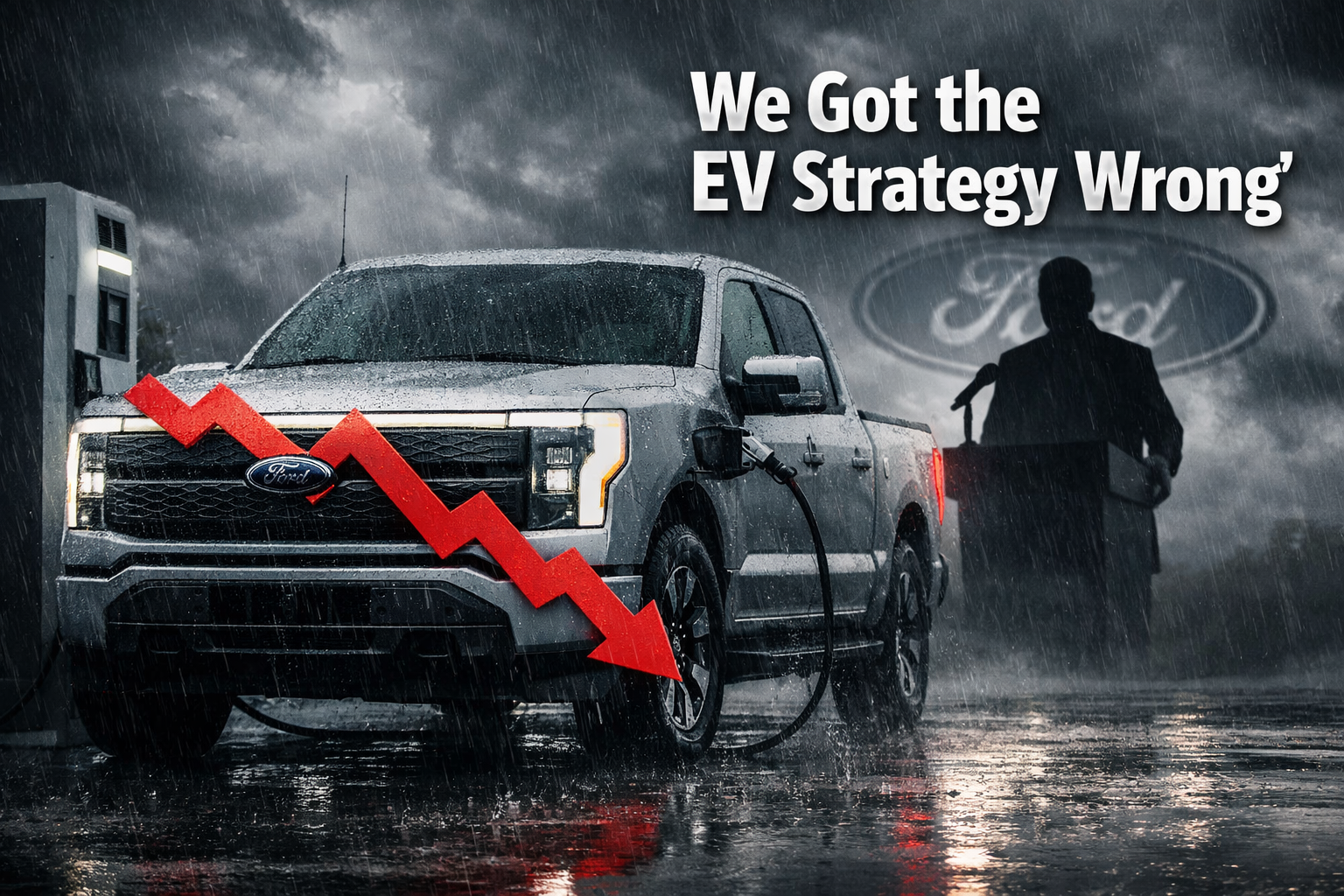
Admissions of strategic error are rare in corporate America. CEOs typically attribute disappointing results to external factors: market conditions, competitor behavior, supply chain disruptions, the macro environment. When Jim Farley, Ford’s CEO, stood before investors and analysts and acknowledged that the company had made specific, identifiable mistakes in its electric vehicle strategy, it was the kind of candor that is simultaneously refreshing and alarming.
Thank you for reading this post, don't forget to subscribe!The admission is alarming not because Ford is alone in its EV struggles but because Ford is a bellwether. What happened to Ford’s EV strategy, why it happened, and what the company is doing differently reveals a great deal about the broader challenges facing legacy automakers attempting the most complex technology transition in the industry’s history.
What Farley Actually Said
Farley’s public comments on the EV strategy errors centered on several specific failures. First, that the company underestimated how much the gas-engine prejudice of its engineering culture would slow EV development. Ford’s best engineers had built careers mastering internal combustion engines, and the institutional instinct to apply ICE-era thinking to EV architecture produced vehicles that were heavier, more expensive, and less software-integrated than they needed to be.
Second, that Ford moved too quickly to scale EV production capacity before validating that its products were cost-competitive at target volumes. The F-150 Lightning and Mustang Mach-E are genuinely capable vehicles with strong customer satisfaction scores. The problem is that Ford was losing significant money on each unit sold, and the path to profitability required a vehicle cost structure that the company had not fully solved before committing to large-scale production investment.
The Loss Per Vehicle Reality: At peak, Ford was reportedly losing tens of thousands of dollars on each Lightning sold when full production and overhead costs were allocated. A business cannot scale its way out of that kind of unit economics problem without fundamentally restructuring how the vehicle is designed and built.
The Three Core Mistakes Ford Made
Mistake 1: Applying ICE Thinking to EV Architecture
Electric vehicles are fundamentally different from internal combustion engine vehicles in ways that go beyond the powertrain. EVs have different weight distribution requirements, different thermal management challenges, different software integration needs, and different manufacturing processes. Approaching EV development with teams whose expertise and instincts were shaped by decades of ICE engineering produced vehicles that solved EV problems with ICE solutions.
The Lightning, for example, carried significant weight from its battery pack partly because the overall vehicle architecture was designed to accommodate a battery that was treated as a drop-in replacement for the engine and fuel tank rather than as the structural and functional centerpiece of a purpose-built electric vehicle. Tesla’s approach from day one was to design vehicles around the battery, which produced fundamentally different and more efficient results.
Mistake 2: Racing Production Scale Before Cost Structure Was Solved
Ford invested heavily in scaling Lightning production at the Rouge Electric Vehicle Center before the engineering team had achieved the design maturity needed to manufacture the vehicle at target costs. The pressure to demonstrate EV commitment to investors, respond to Tesla’s market share gains, and qualify for EV tax credits and government support created urgency that overrode the discipline needed to solve the cost problem before scaling.
This sequencing error is expensive in both directions: the capital invested in premature scale cannot easily be redeployed, and the reputational cost of publicly visible per-unit losses creates a narrative about EV economics that is hard to separate from the broader industry context even when the specific problems are being addressed.
Mistake 3: Software Integration Underinvestment
Ford’s EV owners consistently report that the over-the-air software update experience, one of the most valued features of Tesla ownership, lags significantly behind what Tesla delivers. The ability to improve a vehicle’s performance, add features, and fix problems through software updates after purchase is both a functional advantage and a customer relationship tool that Ford’s software investment has not matched.
Farley acknowledged that Ford treated software as a feature rather than as the foundation of the EV customer experience, and that rebuilding the company’s software capabilities to the level required for competitive EV ownership experience is a multi-year effort that is underway but not complete.
What Ford Is Changing
Ford has restructured its EV and software operations multiple times since the initial EV push, separating the Model e EV division from the Ford Blue ICE business with the explicit goal of creating a startup-like environment for EV development insulated from the cultural gravitational pull of the larger ICE organization.
The company has also delayed several planned EV launches to allow more time for cost reduction engineering, partnered with suppliers on battery technology to reduce cell costs, and is designing its next generation of EVs from the ground up with software-defined architecture as the starting point rather than the finishing layer.
The Commercial EV Pivot
One area where Ford’s EV strategy is genuinely working is commercial vehicles. The E-Transit and E-Transit Custom have found strong demand from fleet operators who can quantify the total cost of ownership advantage of electric operation on predictable routes. The commercial EV opportunity is less glamorous than the consumer Lightning story but is structurally more straightforward: fleet buyers make rational TCO decisions rather than emotional purchase decisions, the use case is predictable, and the charging infrastructure problem is manageable at depot scale.
What This Means for the EV Industry
Ford’s public admission of strategic error is useful precisely because it is specific. The mistakes Farley identified, ICE-era engineering instincts, premature scaling, and software underinvestment, are not Ford-specific failures. They are predictable failure modes for any large legacy automaker attempting the EV transition.
General Motors, Stellantis, Toyota, and Volkswagen have all experienced versions of the same problems. The automakers that navigate the transition most successfully will be those that most completely separate EV development from the cultural and organizational inertia of their ICE businesses while maintaining the manufacturing scale and supplier relationships that give them advantages pure EV startups lack.
- GM’s Ultium platform has shown promise in commercial applications but consumer EV sales have lagged targets
- Volkswagen’s ID series has struggled with software quality issues that have damaged its EV reputation in Europe
- Toyota’s hybrid-focused approach is generating strong profitability but risks ceding EV market position to faster-moving competitors
- Stellantis has delayed multiple EV launches citing the need to improve cost structure before scaling
Bottom Line: Ford’s CEO admitting EV strategy errors is the most honest public accounting of legacy automaker EV transition challenges we have seen from a major executive. The mistakes were real, the consequences were expensive, and the path forward requires exactly the kind of fundamental rethinking that Ford is now, belatedly, undertaking. The EV transition is not over for Ford. It is being reset on more realistic foundations.
Related: Donut Lab Solid-State Battery EV Breakthrough | Einride Self-Driving Trucks | Best Electric Vehicles to Buy in 2025
Stay Informed With the Latest & Most Important News


Top News
- Google’s AI-Powered Workspace in Search Is Now Available to All US Users: Here Is What Actually Changed

- How Jeffrey Epstein Used Silicon Valley’s Network: What the Reporting on Reid Hoffman and Tech’s Elite Reveals

- Where to Preorder the iPhone 17E Right Now: Every Deal Ranked Before the March 11 Launch

- Google Apps Experience and Games Level Up: The Programs That Could Cut Your Play Store Commission Significantly

- Google Is Not Waiting for a Settlement: It Just Killed the 30 Percent App Store Fee Unilaterally














Advertisement