

Now Reading: Anthropic Claude Is Down: What to Do When Your AI Goes Offline and How to Prepare So It Never Stops You
-
01
Anthropic Claude Is Down: What to Do When Your AI Goes Offline and How to Prepare So It Never Stops You
Anthropic Claude Is Down: What to Do When Your AI Goes Offline and How to Prepare So It Never Stops You

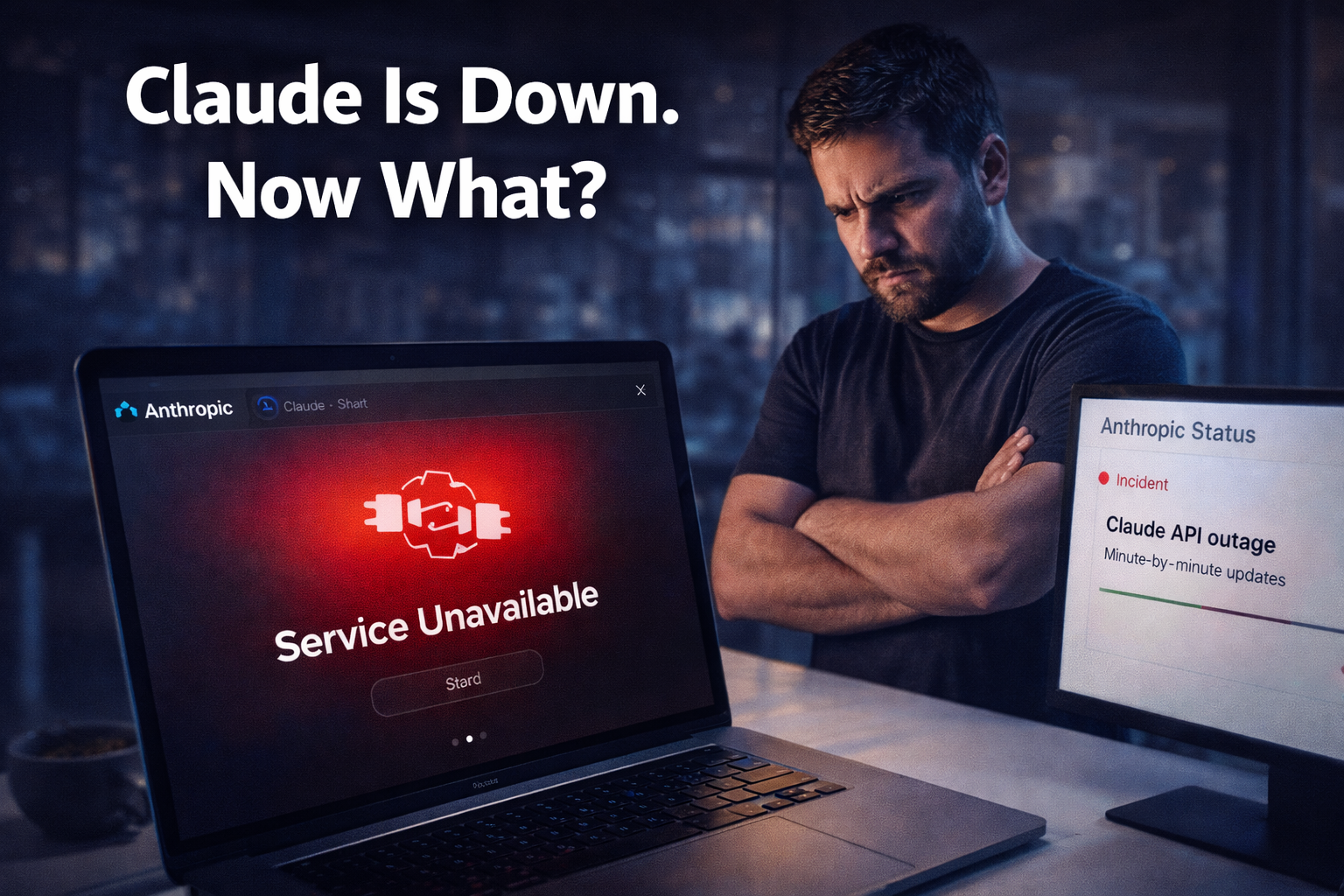
Claude went down. For the tens of thousands of developers, businesses, and individual users who have built their workflows around Anthropic’s AI platform, a widespread outage is not a minor inconvenience. It is a productivity emergency that reveals exactly how dependent modern knowledge work has become on AI infrastructure that can, without warning, become unavailable.
Thank you for reading this post, don't forget to subscribe!Anthropic confirmed a widespread Claude outage affecting both the consumer interface at Claude.ai and the API used by developers and enterprise customers. The incident underscores a dependency risk that most AI adopters have not fully thought through, and it is an opportunity to do exactly that thinking before the next outage occurs.
What Caused the Claude Outage
Anthropic’s status page confirmed a service disruption affecting API availability and the Claude.ai web interface. The specific technical cause, as with most major service outages, involves a combination of infrastructure components whose individual reliability does not guarantee system-level reliability when they interact at scale.
AI platforms at Anthropic’s scale run on complex distributed systems: inference clusters that run the actual model computations, load balancers that route requests, database systems that manage user sessions and conversation history, authentication services, and content delivery infrastructure. A failure or performance degradation in any of these layers can cascade into the user-visible service degradation or complete unavailability that constitutes an outage.
Why AI Outages Are Different From Traditional Software Outages
A traditional software application going down typically means specific features are unavailable while others continue to work. An AI platform outage is more total: because the AI model is the core of every feature, when inference is unavailable, the entire product stops functioning. There is no degraded mode where Claude answers questions more slowly. It either works or it does not.
This all-or-nothing characteristic makes AI platform dependencies riskier for business-critical workflows than equivalent dependencies on traditional software. The risk is worth managing explicitly rather than discovering during a production incident.
Check the Status Page First: Anthropic maintains a public status page at status.anthropic.com that provides real-time information about API and Claude.ai availability, historical incident records, and updates during active incidents. Bookmarking this page is the first step in managing Claude dependency in professional workflows.
What to Do Right Now If Claude Is Down
- Check status.anthropic.com to confirm this is a platform outage and not a local connectivity issue on your end.
- Check Anthropic’s official X account for real-time updates during active incidents; the company typically posts updates as the incident is investigated.
- If using Claude via API, implement retry logic with exponential backoff rather than failing immediately; brief disruptions often resolve within minutes.
- Switch to an alternative model for time-sensitive tasks while the outage persists.
- Document what you were working on so you can resume without losing context when service is restored.
The Best Claude Alternatives During an Outage
ChatGPT (OpenAI): The most capable general-purpose alternative. GPT-4o handles most tasks that Claude performs well, with similar quality for writing, analysis, and coding. Access at chat.openai.com.
Google Gemini: Particularly strong for tasks involving Google Workspace integration, research using web search grounding, and multimodal tasks involving images and documents. Access at gemini.google.com.
Microsoft Copilot: Best alternative for users deeply embedded in Microsoft 365, offering AI assistance within Word, Excel, Teams, and Outlook without switching to a separate interface.
Perplexity AI: Excellent for research tasks where web-grounded answers are important. Not a direct Claude replacement for creative writing or coding but strong for information retrieval.
Local models via Ollama: For developers, running Llama 3 or Mistral locally via Ollama provides full AI capability with zero external dependency. The model quality is lower than Claude for complex tasks but entirely outage-proof.
How to Build AI Workflows That Survive Outages
Multi-Provider API Architecture
The most robust approach for developers and businesses building on AI APIs is a multi-provider architecture with automatic failover. Rather than hardcoding a single provider, implement an abstraction layer that can route requests to OpenAI, Google, or a local model when the primary provider is unavailable. Libraries like LiteLLM provide exactly this kind of provider-agnostic interface for common AI tasks.
Graceful Degradation for AI-Dependent Features
Applications built on AI APIs should implement graceful degradation: when the AI layer is unavailable, the application should fall back to reduced functionality rather than complete failure. A writing assistant that cannot connect to Claude should still allow users to write and save manually, rather than blocking access to the document entirely.
Caching Frequently Used Outputs
For applications where the AI generates content that is the same or similar for many users, caching AI outputs eliminates the dependency on real-time API availability for a significant portion of requests. Static AI-generated content that updates periodically is fundamentally more reliable than dynamic per-request AI generation.
The Broader Lesson About AI Infrastructure Dependency
The Claude outage is a prompt for a dependency audit that most organizations using AI have not conducted systematically. For each workflow that depends on AI, the questions to answer are: what happens to this workflow when AI is unavailable, is that outcome acceptable for the business, and if not, what is the contingency?
The goal is not to avoid AI dependency but to manage it thoughtfully. The productivity gains from AI-integrated workflows are real and worth the dependency they introduce. Managing that dependency with status monitoring, alternative providers, and graceful degradation design is the professional response to living in a world where AI infrastructure, like all infrastructure, occasionally fails.
Bottom Line: Claude outages happen and will continue to happen as the platform scales. The developers and businesses that handle them smoothly are the ones who planned for them in advance. Bookmark the status page, keep one alternative model account active, and design your AI workflows with the assumption that any single provider will be unavailable for hours per year. That preparation costs almost nothing and eliminates a category of emergency.
Related: Downdetector and Speedtest Sold to Accenture | TikTok Down Oracle Outage | Who Owns Your Company’s AI Layer
Related Posts

Stay Informed With the Latest & Most Important News


Top News
- Google’s AI-Powered Workspace in Search Is Now Available to All US Users: Here Is What Actually Changed
- How Jeffrey Epstein Used Silicon Valley’s Network: What the Reporting on Reid Hoffman and Tech’s Elite Reveals

- Where to Preorder the iPhone 17E Right Now: Every Deal Ranked Before the March 11 Launch

- Google Apps Experience and Games Level Up: The Programs That Could Cut Your Play Store Commission Significantly

- Google Is Not Waiting for a Settlement: It Just Killed the 30 Percent App Store Fee Unilaterally













Advertisement