

Now Reading: Zillow’s CEO on Growing Through a Housing Crisis: The Strategy That Is Keeping America’s Real Estate Platform Relevant
-
01
Zillow’s CEO on Growing Through a Housing Crisis: The Strategy That Is Keeping America’s Real Estate Platform Relevant
Zillow’s CEO on Growing Through a Housing Crisis: The Strategy That Is Keeping America’s Real Estate Platform Relevant

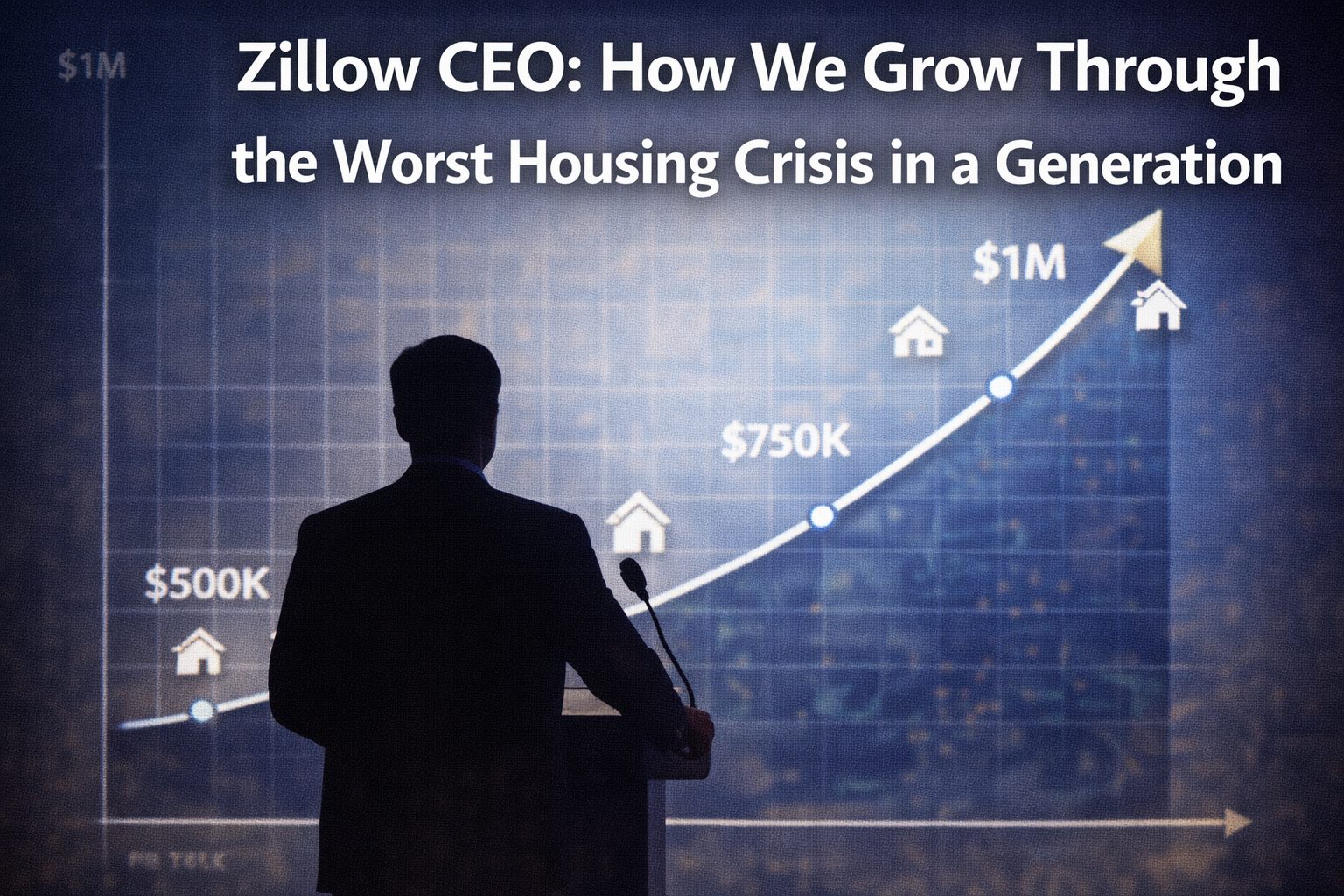
The US housing market is in a structural crisis with no clear resolution timeline. Mortgage rates that nearly tripled from their pandemic-era lows have created a lock-in effect that is keeping existing homeowners from selling, which suppresses inventory for buyers who can afford to buy at current rates. New construction has not kept pace with household formation for over a decade. And affordability, measured by the share of median household income required to purchase a median-priced home, has reached historical extremes.
Thank you for reading this post, don't forget to subscribe!For Zillow, the company whose business model depends on transaction volume in a market that has experienced its worst transaction environment in decades, this is an existential stress test. Rich Barton, Zillow’s co-founder and CEO, has a perspective on navigating this crisis that is worth understanding both for what it reveals about Zillow’s strategy and for what it implies about the future of real estate technology.
The Lock-In Effect and What It Has Done to Zillow
The mortgage rate lock-in effect has reduced existing home sale transaction volume by approximately a third from its peak, which is the single largest factor in Zillow’s revenue compression over the past two years. When homeowners who locked in 3 percent mortgages in 2020 and 2021 are unwilling to sell because doing so would require financing a new purchase at 7 percent or higher, the inventory available for buyers contracts, transactions fall, and the real estate agent market that Zillow’s Premier Agent business serves shrinks correspondingly.
Barton’s response to this structural headwind has been to invest through the cycle rather than contract through it: expanding Zillow’s capabilities in the parts of the market that remain active, building the technology infrastructure for a transaction experience that will be competitive when volume recovers, and using the reduced competition in a difficult market to test approaches that would be harder to validate in a hot market.
The Integrated Transaction Vision
Zillow’s strategic direction under Barton is toward becoming the integrated platform through which the entire home buying and selling transaction flows, rather than just the search and discovery layer where it has historically dominated. This vision includes financing through Zillow Home Loans, agent services through Premier Agent, closing coordination, and potentially escrow and title, all connected through a single consumer interface that reduces the friction of the multi-vendor transaction experience that currently defines US real estate.
This vertical integration strategy is commercially logical and technically demanding. Real estate transactions involve regulatory complexity, state-by-state licensing requirements, and established incumbent relationships in every component of the transaction stack. Assembling a consumer-friendly integrated experience across all of these components is a multi-year effort that Barton has been pursuing through a combination of internal development and strategic partnerships.
The Amazon Parallel: Barton has used language in investor contexts that draws an explicit parallel between Zillow’s integrated transaction ambition and Amazon’s move from e-commerce search to fulfillment ownership. The analogy is imperfect, real estate transactions are local, regulated, and relationship-dependent in ways that physical goods e-commerce is not, but the strategic logic of capturing more of the transaction rather than just the discovery is directly analogous.
How AI Is Changing Zillow’s Product
AI-Powered Search and Discovery
Zillow has deployed AI improvements to its search and listing discovery experience that represent the most significant changes to the core product in years. Natural language search, allowing buyers to describe what they want in conversational terms rather than filtering by specific attributes, produces results that better match the subjective experience of home preferences than traditional filter-based search.
The AI listing analysis features that generate automatic summaries of property strengths and potential concerns, pulling from listing descriptions, photos, and historical data, reduce the information processing burden on buyers evaluating large numbers of listings. For a market where buyers need to move quickly on attractive properties, reducing the time required to form a confident view of each listing has real commercial value.
Agent Effectiveness Tools
Zillow’s Premier Agent business has shifted toward providing agents with AI tools that improve their effectiveness rather than just with lead volume. AI-generated outreach suggestions, automated follow-up drafting, and market intelligence tools help agents convert a higher percentage of the leads they receive, which improves both agent outcomes and Zillow’s own revenue per lead.
What Barton Sees That Skeptics Miss
Barton’s most distinctive public argument about the current market is that the lock-in effect, while severe, is temporary and will resolve in a way that releases enormous pent-up transaction demand. The millions of homeowners who would prefer to move but cannot economically afford to are not permanently frozen. They are waiting for a rate environment that makes relocation less painful.
When that environment arrives, whether through rate normalization, adjustment to higher rates as the new normal, or the accumulation of life events that force transactions regardless of rate environment, Zillow’s investment in platform capabilities and market share during the freeze period positions it to capture a disproportionate share of the release.
The Rental Market Offset
A strategic counterweight to the weak sales market has been growth in Zillow’s rental platform. The same affordability conditions that suppress ownership demand support rental demand: households that cannot afford to buy need to rent, and the rental market has remained active through the sales market freeze.
Zillow’s rental listings platform has grown its share of the apartment and single-family rental search market, and the company has invested in tools for landlords and property managers that extend its relationships beyond the buyer-seller transaction context. Whether the rental platform can generate sufficient revenue to offset sales market weakness at the margin is an open question, but it represents real and growing diversification.
Bottom Line: Barton’s strategy for Zillow through the housing crisis is counter-cyclical investment in platform capability and market position, betting that the transaction volume freeze is temporary and that the integrated transaction platform will be well-positioned for recovery. Whether the bet is correct depends on how long the lock-in effect persists and how completely Zillow can execute the integrated transaction vision before competition and regulation constrain it.
Related: Ford CEO EV Strategy | Three Companies Dominated $189B VC | Silicon Valley Political Crisis
Stay Informed With the Latest & Most Important News



Top News
- Google’s AI-Powered Workspace in Search Is Now Available to All US Users: Here Is What Actually Changed
- How Jeffrey Epstein Used Silicon Valley’s Network: What the Reporting on Reid Hoffman and Tech’s Elite Reveals

- Where to Preorder the iPhone 17E Right Now: Every Deal Ranked Before the March 11 Launch

- Google Apps Experience and Games Level Up: The Programs That Could Cut Your Play Store Commission Significantly

- Google Is Not Waiting for a Settlement: It Just Killed the 30 Percent App Store Fee Unilaterally














Advertisement