

Now Reading: Pokemon Pokopia Review: The Cozy Life Sim That Is Actually a Massive Adventure in Disguise
-
01
Pokemon Pokopia Review: The Cozy Life Sim That Is Actually a Massive Adventure in Disguise
Pokemon Pokopia Review: The Cozy Life Sim That Is Actually a Massive Adventure in Disguise

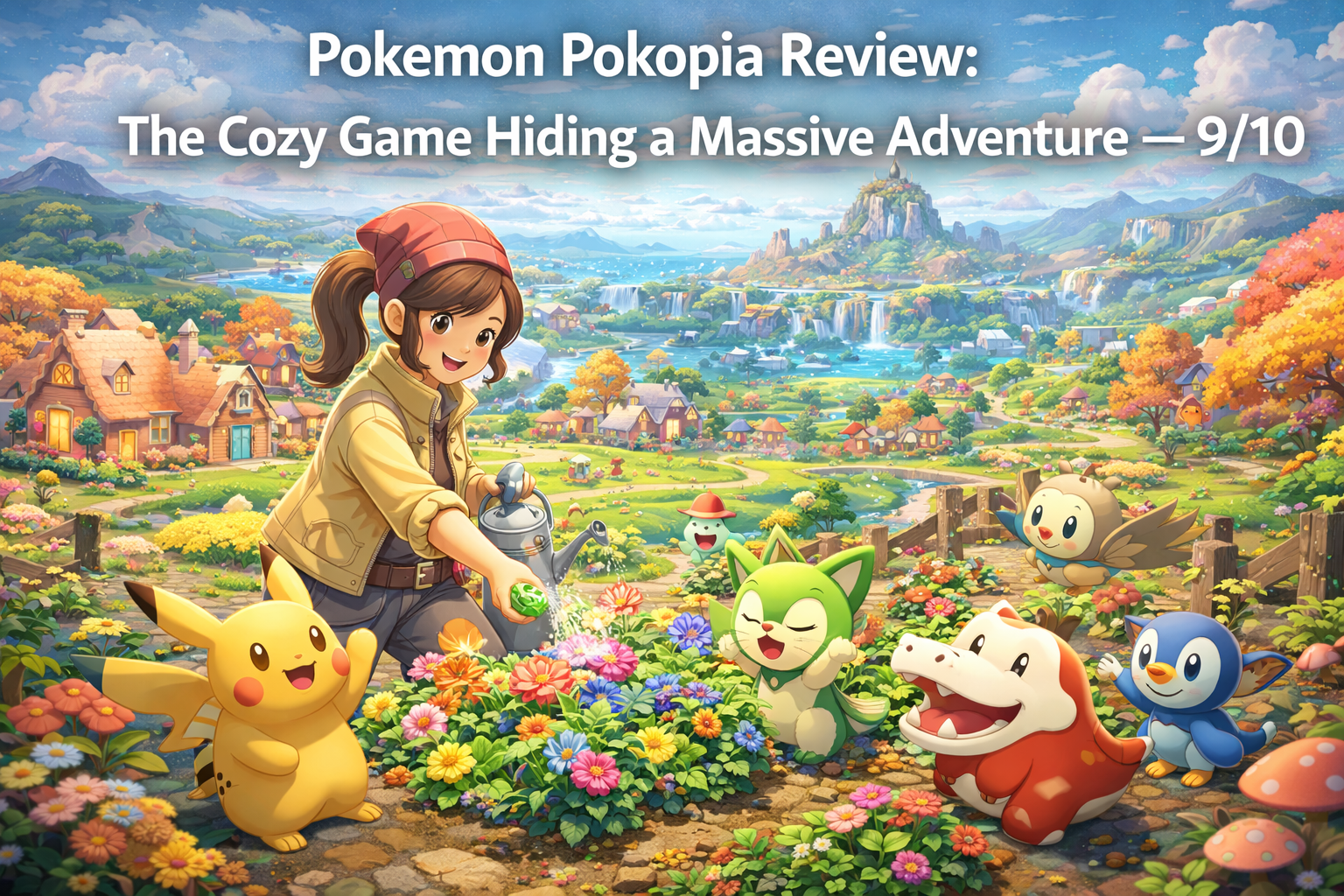
Game Freak has been trying to answer the question of what Pokemon should be for a generation that grew up with the franchise and now wants more than the familiar gym-badge loop. Scarlet and Violet were a wide-open attempt at open-world Pokemon that showed ambition exceeding execution. Pokopia is a different kind of answer: start with something gentle, familiar, and low-stakes, and then slowly reveal that the gentle surface conceals one of the deepest, most emotionally resonant Pokemon experiences in years.
Thank you for reading this post, don't forget to subscribe!Pokopia launches as an apparent lifestyle simulation: you move to a new town, befriend Pokemon who help you build and maintain a home, tend a garden, cook meals, and participate in community events. If this were all it was, it would be a charming but narrow product for a specific slice of the Pokemon audience. What it actually is requires about four hours to begin to understand, and understanding it fully requires more time than most reviewers spend with any game.
The Surface: What Pokopia Looks Like
The visual presentation is immediately disarming in its gentleness. Pokopia renders its world in a warm, rounded aesthetic that is closer to a Studio Ghibli film than to the mainline Pokemon games’ functional creature-collecting style. Your starter home is tiny and imperfect. The Pokemon that move in with you have individual personalities that express themselves in small animations, habits, and preferences that make them feel like genuine companions rather than stat repositories.
The early hours confirm every expectation the marketing has set. You plant seeds, harvest vegetables, learn recipes from the town’s NPCs, participate in seasonal festivals, and gradually upgrade your home and garden. The life sim mechanics are implemented with care and depth: the crafting system is genuinely complex, the Pokemon companion relationship system has meaningful depth, and the seasonal rhythm of the world creates a satisfying sense of time passing.
The Shift: When Pokopia Reveals Itself
The first signal that something deeper is operating comes around the four-hour mark, when a seemingly routine errand for a town elder leads to a cave system that has no business being in a cozy life sim. The cave is dark, meaningfully challenging, and populated with Pokemon whose designs carry a weight and darkness that the surface world carefully avoids. Completing the cave errand reveals the first piece of a narrative thread that extends, we eventually understand, through every apparently mundane interaction you have had since the game began.
Without spoiling the specific revelations, Pokopia’s narrative architecture places a genuinely affecting story about memory, loss, and the way communities protect each other from painful truths beneath the cozy surface. The life sim mechanics, which seemed merely charming in the early hours, are revealed as the means through which you rebuild the community’s capacity to face what it has been avoiding. The cooking and gardening are therapy. The friendships are recovery. The home you are building is a metaphor that the game earns rather than announces.
The Design Intention: The cozy aesthetic and gentle early hours are not a tutorial or a genre misrepresentation. They are the scaffolding that makes the deeper story’s emotional impact possible. Players who have spent hours caring about their garden and their Pokemon companions feel the narrative’s darker turns in a way that a conventionally structured game could not produce. The gentleness is load-bearing.
The Pokemon and Companion System
Pokopia introduces a companion bond system that is meaningfully different from the main series’ friendship mechanics. Pokemon who live with you develop preferences, comfort objects, and behavioral quirks through shared experience rather than through battle participation or item use. A Eevee who was present during a rain storm develops a specific animation set that appears whenever it rains. A Snorlax who helped you move furniture walks differently through spaces it helped clear.
These details accumulate into companion relationships that feel earned in a way that main series Pokemon friendships rarely do. When the narrative asks you to make decisions that affect your companions, the game has done the work to make those decisions feel genuinely difficult.
The Adventure Dimension
As the story develops, Pokopia’s adventure content expands to include exploration systems, puzzle-based dungeon sequences, and encounter mechanics that borrow from the mainline games while adapting them to Pokopia’s tonal register. Battles exist but are framed differently, as moments of confrontation with the past rather than as competitive sport, and the resolution of encounters is more often dialogue and understanding than defeat and capture.
The adventure content is substantial enough that players approaching Pokopia primarily as a life sim will be surprised by how much game is here. And players who come for the adventure will find that the life sim foundation gives the adventure emotional stakes that equivalent content in the mainline series rarely achieves.
Who Pokopia Is For
- Pokemon fans who have felt the franchise has become emotionally shallow and want a game that takes its world’s emotional stakes seriously
- Cozy game fans who want more depth beneath the comfortable surface and are willing to be surprised by where a gentle start leads
- Players who enjoyed Stardew Valley’s ability to embed meaningful story within repetitive domestic mechanics
- Anyone who has wanted to spend time with Pokemon as companions rather than as competitive tools
Bottom Line: Pokemon Pokopia is the most emotionally ambitious Pokemon game in years, hidden inside the most approachable packaging the franchise has ever used. It requires patience and rewards it generously. The cozy surface is the point, not a compromise. This is what it looks like when Game Freak takes the quiet parts seriously. Score: 9/10
Related: Scott Pilgrim Creator New Game Seconds | Console Exclusives Comeback | Best Nintendo Switch Games 2025
Related Posts


Stay Informed With the Latest & Most Important News
Previous Post
Next Post


Top News
- Google’s AI-Powered Workspace in Search Is Now Available to All US Users: Here Is What Actually Changed

- How Jeffrey Epstein Used Silicon Valley’s Network: What the Reporting on Reid Hoffman and Tech’s Elite Reveals

- Where to Preorder the iPhone 17E Right Now: Every Deal Ranked Before the March 11 Launch

- Google Apps Experience and Games Level Up: The Programs That Could Cut Your Play Store Commission Significantly

- Google Is Not Waiting for a Settlement: It Just Killed the 30 Percent App Store Fee Unilaterally














Advertisement