

Now Reading: Seven Tech Giants Just Signed Trump’s Data Center Power Pledge: Here Is What They Agreed To and What They Get Back
-
01
Seven Tech Giants Just Signed Trump’s Data Center Power Pledge: Here Is What They Agreed To and What They Get Back
Seven Tech Giants Just Signed Trump’s Data Center Power Pledge: Here Is What They Agreed To and What They Get Back

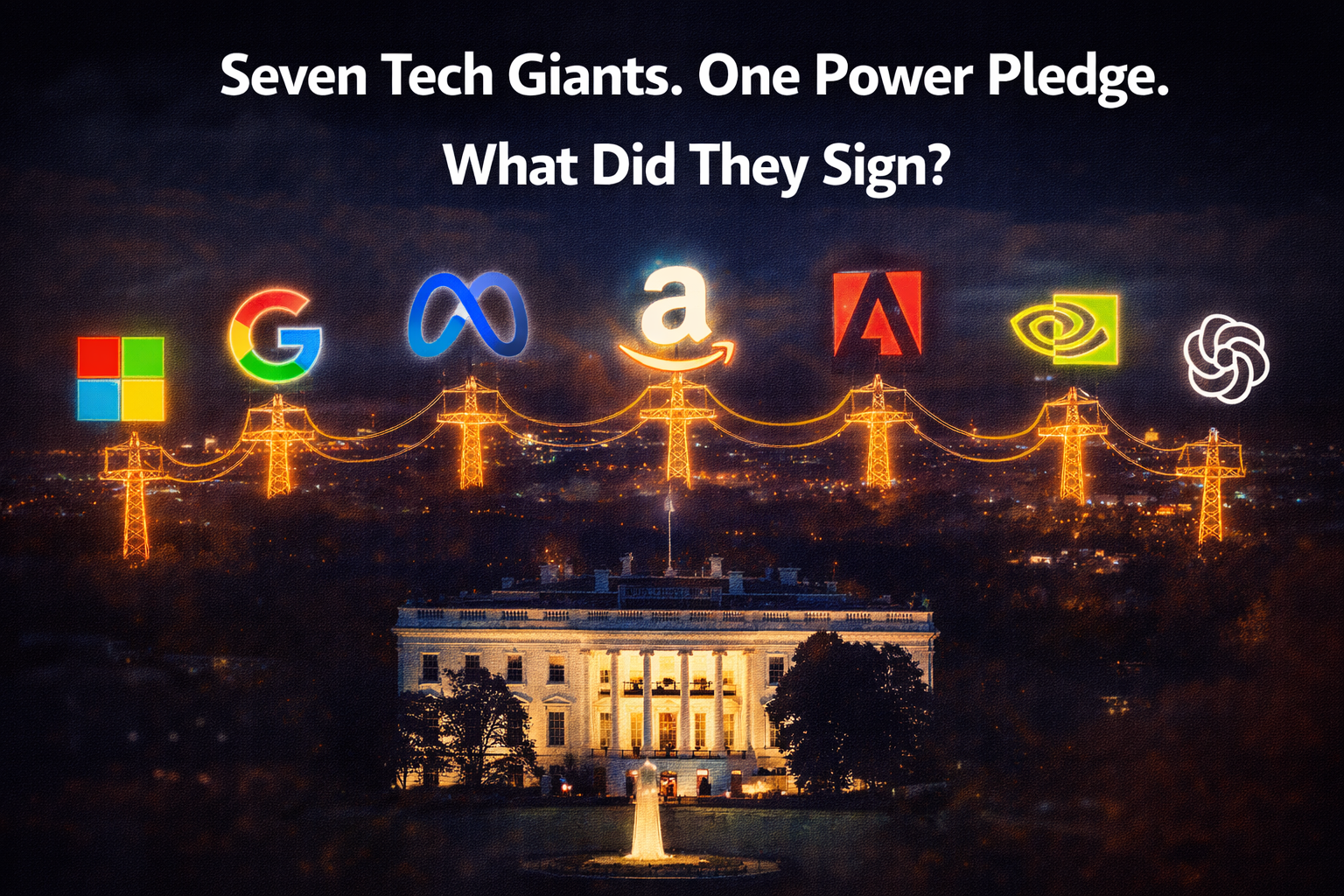
Amazon, Microsoft, Google, Meta, Oracle, and two other major technology companies have signed a White House pledge committing to measures designed to prevent data center energy demand from driving significant increases in residential and commercial electricity costs for other grid users. The pledge is the Trump administration’s attempt to manage the political tension between its enthusiastic support for AI infrastructure investment and the growing public concern about data centers straining local power grids and pushing up utility bills.
Thank you for reading this post, don't forget to subscribe!Understanding what the companies actually committed to, what they receive in exchange, and whether the pledge has meaningful teeth requires looking beyond the headline number and into the specific commitments and the enforcement mechanism, or lack thereof.
What the Pledge Contains
New Generation Commitments
The pledge commits signatory companies to investing in new electricity generation capacity proportional to the power demand their data center expansion creates, rather than drawing exclusively from existing grid capacity. The specific forms of generation investment include onsite generation at data center facilities, power purchase agreements with new renewable generation projects, and direct investment in grid infrastructure upgrades in markets where data center growth is creating capacity constraints.
The rationale is that data centers that add power demand without adding power supply are effectively transferring grid strain to existing utility customers, including residential consumers, who then face higher rates through normal utility cost allocation mechanisms. New generation investment by data center operators that is proportional to their demand growth insulates other grid users from that demand growth’s cost consequences.
Siting Commitments
The pledge includes commitments to prioritize data center siting in markets with surplus power capacity rather than concentrating new construction in already-constrained markets like Northern Virginia and Silicon Valley. The practical challenge of this commitment is that the markets with surplus power capacity are often not the same markets with the fiber infrastructure, talent pools, and latency characteristics that optimal data center siting requires.
The Siting Tension: The best power grid locations for new data centers and the best network infrastructure locations for new data centers are rarely the same place. Northern Virginia has among the best fiber connectivity in the world and among the most constrained power capacity. West Texas has surplus renewable power and limited fiber. Commitments to site in power-rich markets are real commitments with real operational costs.
What the Tech Companies Get in Return
The pledge is not purely altruistic. Signatories receive several forms of administrative cooperation that have significant commercial value. Expedited permitting processes for new data center construction in priority markets reduce the timeline from site selection to operational facility. Streamlined utility interconnection processes address one of the most significant bottlenecks in data center deployment, the multi-year wait for grid connection approval that constrains how fast companies can build even when they have the capital and the land.
The pledge also provides political cover for AI infrastructure investment. By visibly committing to cost protection for residential electricity customers, the tech companies gain a narrative tool to use against local opposition to data center development, which has been growing in communities that have seen utility rates increase following large data center deployments.
How the Seven Companies’ Commitments Differ
Amazon Web Services: Has committed most specifically to new nuclear power investment, including small modular reactor purchase agreements and reactivation support for existing nuclear facilities.
Microsoft: Has the most aggressive renewable energy portfolio among the signatories and has been the most public about its carbon negative commitments that create parallel obligations to the pledge terms.
Google: Has committed to 24/7 carbon-free energy matching in all markets where it operates data centers, a more demanding standard than annual renewable energy matching that most of its peers use.
Meta: Has focused on wind and solar purchase agreements and has been less involved in the nuclear conversations that Amazon and Microsoft are driving.
Oracle: New to large-scale data center operation but is scaling rapidly through its AI cloud partnerships and has committed to new generation investment proportional to its planned expansion.
Whether the Pledge Has Enforcement Teeth
The pledge is a voluntary commitment without statutory enforcement mechanisms. The consequences for non-compliance are primarily reputational and political rather than legal or regulatory. This structure has drawn criticism from utility consumer advocates who argue that voluntary pledges by companies whose commercial interest in grid access exceeds their interest in rate protection for other customers are unlikely to be honored when they create material commercial costs.
The administration’s ability to deliver on the expedited permitting and interconnection benefits that create incentives for compliance also depends on the cooperation of state utility regulators, local governments, and the Federal Energy Regulatory Commission, none of which are bound by the White House pledge.
Bottom Line: Seven tech giants committing to data center power responsibility is better than no commitment, but the voluntary structure and the diffuse enforcement mechanism mean the pledge is more useful as political narrative than as binding constraint. The companies that honor it in substance will be those for whom the reputational and commercial benefits of demonstrating responsible grid citizenship exceed the cost of the commitments. Watch the siting decisions and generation investments over the next 18 months for evidence of substance.
Related: Offshore Floating Data Centers | A16z $1.7B AI Infrastructure Fund | Donut Lab Solid-State Battery EVs
White House AI infrastructure policy
Related Posts

Stay Informed With the Latest & Most Important News



Top News
- Google’s AI-Powered Workspace in Search Is Now Available to All US Users: Here Is What Actually Changed

- How Jeffrey Epstein Used Silicon Valley’s Network: What the Reporting on Reid Hoffman and Tech’s Elite Reveals
- Where to Preorder the iPhone 17E Right Now: Every Deal Ranked Before the March 11 Launch

- Google Apps Experience and Games Level Up: The Programs That Could Cut Your Play Store Commission Significantly

- Google Is Not Waiting for a Settlement: It Just Killed the 30 Percent App Store Fee Unilaterally












Advertisement