

Now Reading: Three Companies Just Captured Most of $189 Billion in Global VC: The Most Concentrated Funding Month in History
-
01
Three Companies Just Captured Most of $189 Billion in Global VC: The Most Concentrated Funding Month in History
Three Companies Just Captured Most of $189 Billion in Global VC: The Most Concentrated Funding Month in History

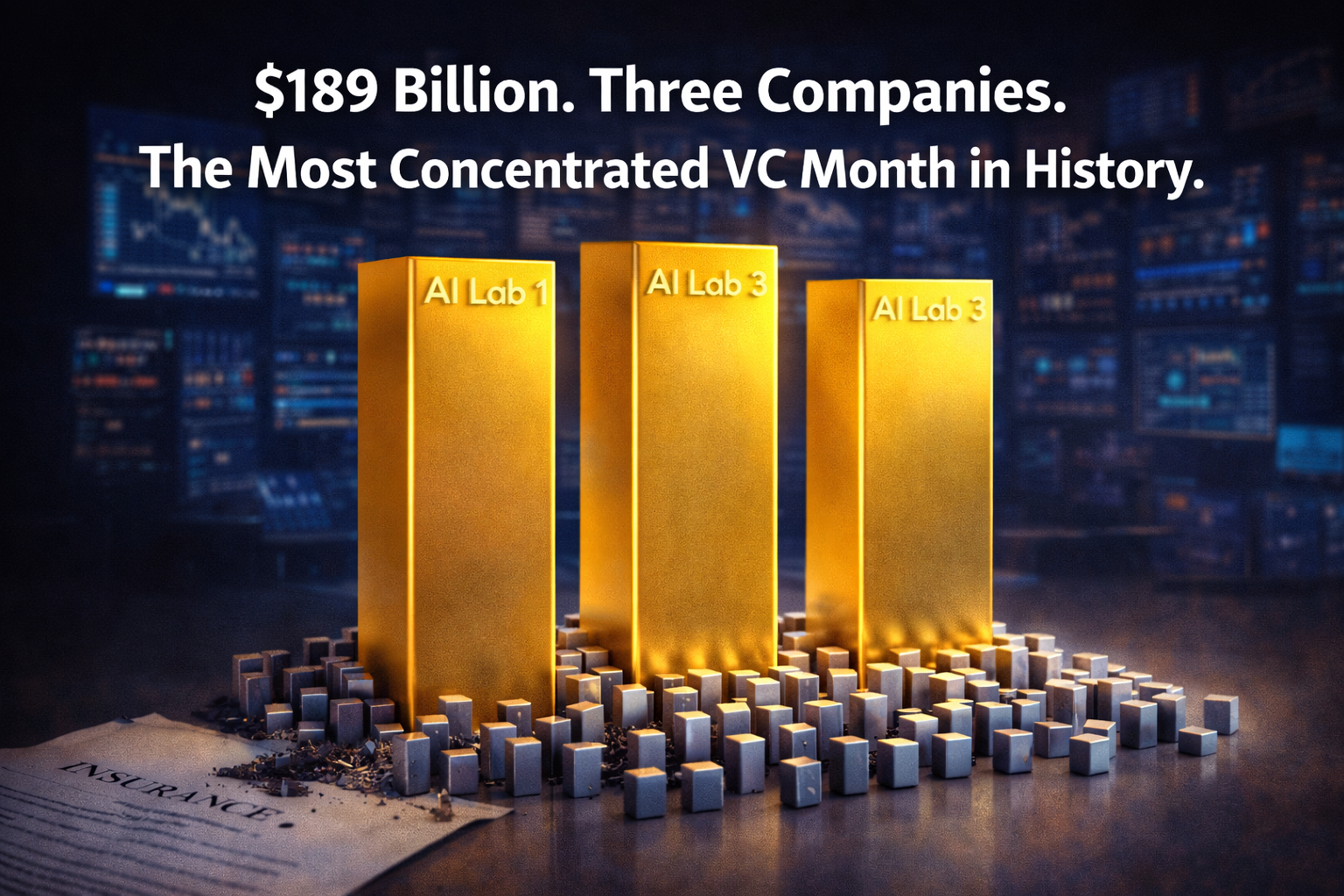
Venture capital data for the month showed a number that made the industry pause: global VC investment exceeded $189 billion. Then came the detail that made that number meaningful in a different way: the majority of that capital flowed to just three companies, all of them AI-focused, all of them raising at valuations that would have seemed implausible five years ago.
Thank you for reading this post, don't forget to subscribe!This level of funding concentration is not just a record. It is a structural signal about what is happening in the venture capital market and what the implications are for the thousands of startups competing for the remaining capital.
The Three Companies and What They Raised
The specific composition of the three dominant raises reflects the current AI investment thesis at its most concentrated. OpenAI’s ongoing capital raises, Anthropic’s capacity funding rounds, and xAI’s infrastructure investment have between them captured investment flows that historically would have been distributed across dozens of companies in multiple sectors.
Each of these companies is raising not primarily because they need capital to operate but because they need capital to build the infrastructure, compute capacity, and talent organization required to remain competitive in the frontier AI race. The capital requirements of frontier model development, when measured in GPU clusters, data center buildouts, and compensation for the small number of researchers capable of operating at this level, are genuinely unlike anything in the venture capital industry’s prior experience.
The Compute Cost Reality: Training a frontier AI model at the scale of GPT-4 or Claude 3 Opus costs hundreds of millions of dollars in compute alone, not counting the research team, data acquisition, safety evaluation, and infrastructure costs. Keeping pace with model capability improvements requires continuous investment at this scale, which is why the largest AI labs are raising billions rather than tens of millions.
What Extreme Concentration Means for the VC Market
Capital Crowding Out Effect
When a large fraction of available VC capital flows to a small number of companies, less capital remains for the broader startup ecosystem. Limited Partners, the pension funds, endowments, and family offices that provide the capital that VCs invest, have finite capital allocations for venture as an asset class. Dollars committed to OpenAI, Anthropic, and xAI at stratospheric valuations are dollars not available for Series A rounds in biotech, climate tech, consumer software, and the hundreds of other categories that also need venture capital.
The crowding out effect is not absolute, because total LP allocations to venture have been increasing alongside AI enthusiasm. But the mathematical reality of capital concentration means that the fundraising environment for non-AI startups has become harder as AI captures an increasing share of available dollars.
Valuation Benchmarking Distortion
The valuations of the three dominant companies, ranging from tens of billions to hundreds of billions of dollars for companies with revenue that does not approach those numbers, create benchmarking distortions throughout the market. Founders of smaller AI startups point to these valuations when negotiating their own rounds, and investors who decline to pay analogous multiples are accused of not understanding AI’s potential.
The problem is that OpenAI, Anthropic, and xAI are receiving capital from investors who believe they are buying stakes in the companies that will provide the foundational AI infrastructure for the next technological era. Whether that belief is correct, and whether the companies can justify their valuations through revenue and margins that accrue to shareholders, is genuinely uncertain and will be resolved only over many years.
What This Means for Non-AI Startups
The funding concentration creates a two-tier startup ecosystem that is becoming increasingly visible. AI companies with credible frontier ambitions have access to essentially unlimited capital at premium valuations. Non-AI companies, and AI companies without clear differentiation from the dominant platforms, face a funding environment that is significantly more constrained.
This bifurcation is creating interesting dynamics in categories like climate tech, biotech, and deep tech, where the underlying capital requirements are also large but AI enthusiasm has not directed similar LP attention. Some of the most important technology investments of the next decade may be occurring in underfinanced categories while AI captures disproportionate capital.
The VC Firms Benefiting Most
- a16z: The most public AI investment advocate with the largest dedicated AI fund
- Sequoia Capital: Invested in OpenAI early and has been building its AI portfolio aggressively
- Kleiner Perkins: Active across AI infrastructure and application layers
- Spark Capital: Significant AI bets including Anthropic
- Tiger Global and Coatue: Large crossover funds deploying public-market scale capital into late-stage AI rounds
Historical Context: Have We Seen This Before?
The degree of VC concentration visible in the current AI funding environment has precedents, but they require going back to specific technology waves rather than finding recent analogues. The late 1990s dot-com boom showed similar concentration dynamics in internet infrastructure. The 2007 to 2008 period showed concentration in social media platforms. In each case, the concentrated capital reflected genuine transformative potential that the market was trying to capture before the leaders became clear.
What makes the current AI concentration unusual is the scale. The dollar amounts flowing to the top three companies exceed entire previous technology investment waves in single transactions. The question that matters, whether this capital is being deployed productively toward genuine value creation or whether it is creating asset inflation that will eventually correct, is one that no one can definitively answer in real time.
Bottom Line: Three companies capturing the majority of $189 billion in global VC is a signal about AI’s transformative potential and about the structural concentration of capital in early technology waves. For founders not in the top tier, the practical implication is that differentiation, capital efficiency, and clear ROI demonstration are more important than ever. The rising tide of AI enthusiasm is not lifting all boats.
Related: A16z $1.7B AI Infrastructure Fund | AI Startup Equity at Two Prices | What Investors No Longer Want in AI SaaS
Stay Informed With the Latest & Most Important News



Top News
- Google’s AI-Powered Workspace in Search Is Now Available to All US Users: Here Is What Actually Changed

- How Jeffrey Epstein Used Silicon Valley’s Network: What the Reporting on Reid Hoffman and Tech’s Elite Reveals
- Where to Preorder the iPhone 17E Right Now: Every Deal Ranked Before the March 11 Launch

- Google Apps Experience and Games Level Up: The Programs That Could Cut Your Play Store Commission Significantly

- Google Is Not Waiting for a Settlement: It Just Killed the 30 Percent App Store Fee Unilaterally













Advertisement