

Now Reading: He Used Insurance Money From a House Fire to Build PopSockets: The Founder Story That Broke Every VC Rule
-
01
He Used Insurance Money From a House Fire to Build PopSockets: The Founder Story That Broke Every VC Rule
He Used Insurance Money From a House Fire to Build PopSockets: The Founder Story That Broke Every VC Rule

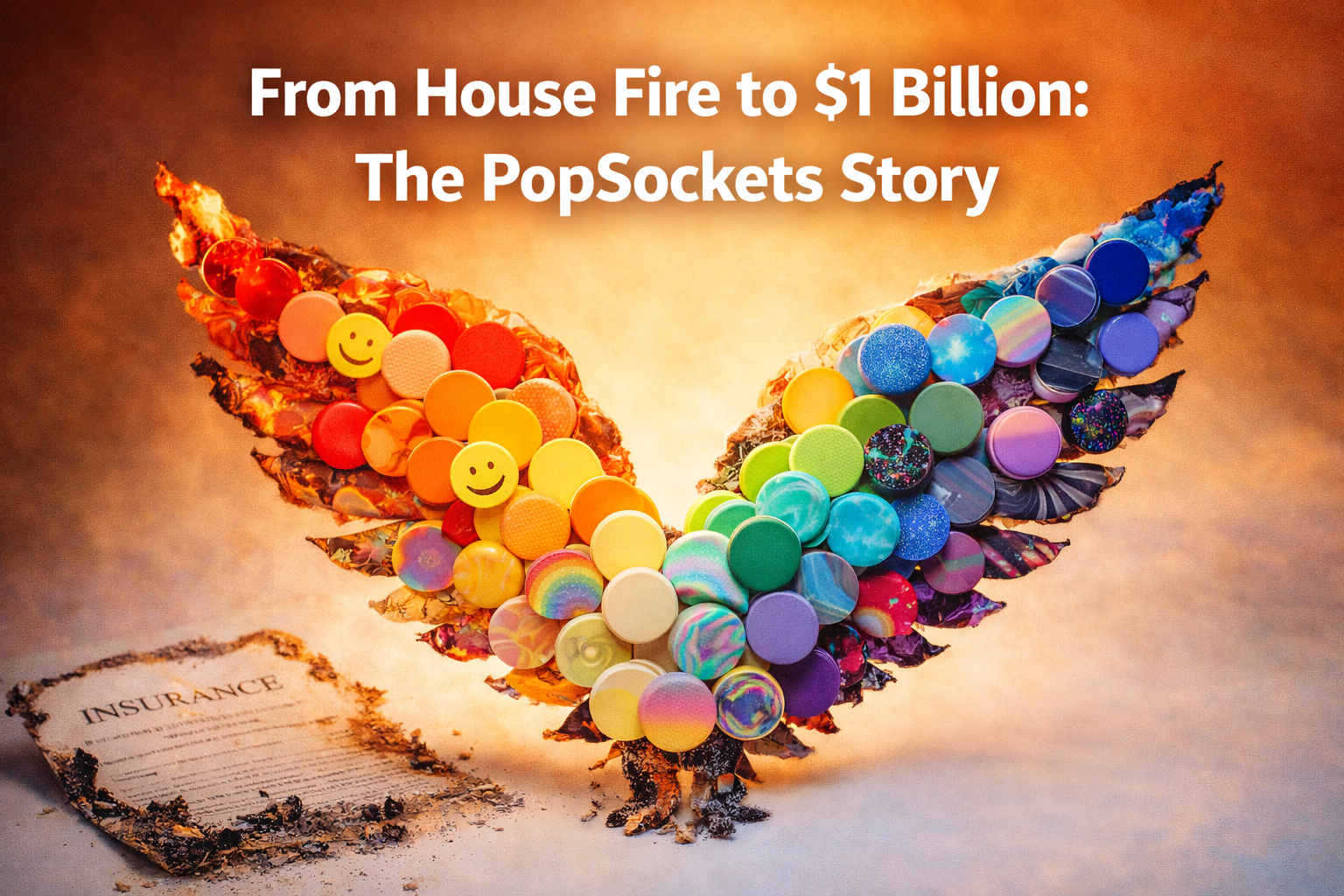
The dominant narrative in consumer hardware startups runs roughly like this: raise venture capital, spend it on engineering and manufacturing, burn cash on customer acquisition, and either achieve the scale needed to justify the burn or run out of money trying. The story of PopSockets, the ubiquitous phone grip and stand that became one of the best-selling consumer accessories in history, breaks every element of this narrative.
Thank you for reading this post, don't forget to subscribe!David Barnett, a philosophy professor at the University of Colorado, founded PopSockets. He received no venture capital in the conventional sense. He used insurance money from a house fire to fund critical early manufacturing. He built the company through a combination of academic rigor, obsessive iteration, and a distribution strategy that consumer electronics VCs would have rejected as insufficiently scalable. The company is worth over a billion dollars.
The Origin Story: Philosophy, Headphone Cords, and a Simple Problem
Barnett’s founding insight came from an annoyance so mundane that it had been overlooked by every consumer electronics company: headphone cords tangle. In 2010, Barnett was frustrated by the constant tangling of his earphone cords and conceived of a collapsible button that could be attached to the back of a phone to serve as a cord wrap. The original design was functional but inelegant, two buttons connected by a piece of elastic.
The transformation from cord wrapper to phone grip happened through iteration. Barnett’s academic training in philosophy, which requires precise problem definition and systematic evaluation of solutions, proved unexpectedly valuable in product development. He applied the same analytical rigor to improving the PopSocket’s function and aesthetics that he applied to philosophical arguments, testing prototypes obsessively and refining based on specific functional criteria rather than general impressions.
The House Fire and the Funding Decision
The conventional startup funding path, angels and seed investors followed by Series A venture capital, was available to Barnett in theory but unappealing in practice. His product was a physical good that required manufacturing investment, and the consumer hardware sector had earned a reputation among VCs for its capital intensity and thin margins.
The insurance payout from a fire that damaged Barnett’s home provided both the capital and the clarity for the next phase. Rather than diluting his equity to access institutional capital with attached expectations about scale and exit timelines, he used insurance proceeds to fund the manufacturing investment that moved PopSockets from handcrafted prototypes to commercially viable product quantities. The funding source was accidental. The decision about how to use it reflected a deliberate philosophy about ownership and control.
The Alternative Financing Model: Barnett’s use of personal funds and insurance proceeds kept him in complete control of PopSockets during its most formative years. When VC-backed competitors attempted to enter the phone grip category, they found a company whose founder had years of unencumbered product iteration experience and no investor pressure to pivot away from the core product in search of faster growth.
The Distribution Strategy VCs Would Have Dismissed
PopSockets’ initial distribution focused on craft fairs, Etsy, and Amazon rather than the big box retail placement that consumer hardware startups typically pursue. This was partly necessity, large retailers require minimum order quantities and payment terms that early-stage hardware companies struggle to meet, and partly philosophy: direct channels provided faster feedback, better margins, and real customer relationship data that retail intermediaries obscure.
The Etsy and Amazon early years built a customer base, refined the product based on direct feedback, and generated the sales history and review volume that made retail negotiations possible from a position of demonstrated demand rather than projected demand. By the time Best Buy and Target were part of the distribution conversation, PopSockets had proof of concept that institutional retailers find compelling in ways that startup pitch decks do not.
The Customization Insight That Scaled the Business
The product insight that transformed PopSockets from a useful accessory into a cultural phenomenon was customization. Barnett made PopSocket tops interchangeable, allowing users to express personal identity through their phone grip the same way they expressed it through phone cases. Licensed designs featuring sports teams, artists, brands, and custom photo printing created a product that was simultaneously functional and personal.
The licensing business that grew from customization became one of PopSockets’ most profitable and defensible revenue streams. Brands pay for the opportunity to be on a product that is physically handled and socially visible dozens of times per day. That brand adjacency value is something that PopSockets’ grip position on the back of a phone provides more consistently than most advertising formats.
What PopSockets Teaches About Consumer Hardware
The PopSockets story is instructive precisely because it achieved outcomes that the standard consumer hardware playbook says are unlikely. A single founding insight, iterated to product-market fit without venture capital, distributed through non-traditional channels, scaled through customization and licensing, and maintained without a growth-at-all-costs mentality, produced a company that has outlasted most of its VC-backed competitors in the phone accessory category.
- Capital efficiency matters more in hardware than software: Every dollar of manufacturing inventory is a dollar not available for iteration or marketing
- Direct-to-consumer channels build customer insight that retail cannot provide: The feedback loop from Etsy reviews to product iteration was faster and richer than anything a retail buyer conversation could produce
- Customization can transform a commodity into a personal expression product: The economics of licensed customization are substantially better than the economics of commodity hardware sales
- Founder control during formative years has compounding value: The ability to iterate the product on Barnett’s timeline rather than an investor’s timeline was critical to PopSockets reaching product-market fit
Bottom Line: David Barnett used house fire insurance money and a philosopher’s analytical rigor to build one of the most successful consumer hardware companies of the past decade without following any of the rules that VCs prescribe for consumer hardware success. The PopSockets story is a masterclass in founder-controlled product development, patient distribution building, and the transformative power of customization as a business model.
Related: AI Startup Equity at Two Prices | What Investors No Longer Want in AI SaaS | Silicon Valley Political Crisis
Related Posts

Stay Informed With the Latest & Most Important News



Top News
- Google’s AI-Powered Workspace in Search Is Now Available to All US Users: Here Is What Actually Changed

- How Jeffrey Epstein Used Silicon Valley’s Network: What the Reporting on Reid Hoffman and Tech’s Elite Reveals

- Where to Preorder the iPhone 17E Right Now: Every Deal Ranked Before the March 11 Launch
- Google Apps Experience and Games Level Up: The Programs That Could Cut Your Play Store Commission Significantly

- Google Is Not Waiting for a Settlement: It Just Killed the 30 Percent App Store Fee Unilaterally












Advertisement