

Now Reading: Who Needs Data Centers in Space When They Can Float Offshore? The Serious Case for Ocean-Based AI Infrastructure
-
01
Who Needs Data Centers in Space When They Can Float Offshore? The Serious Case for Ocean-Based AI Infrastructure
Who Needs Data Centers in Space When They Can Float Offshore? The Serious Case for Ocean-Based AI Infrastructure

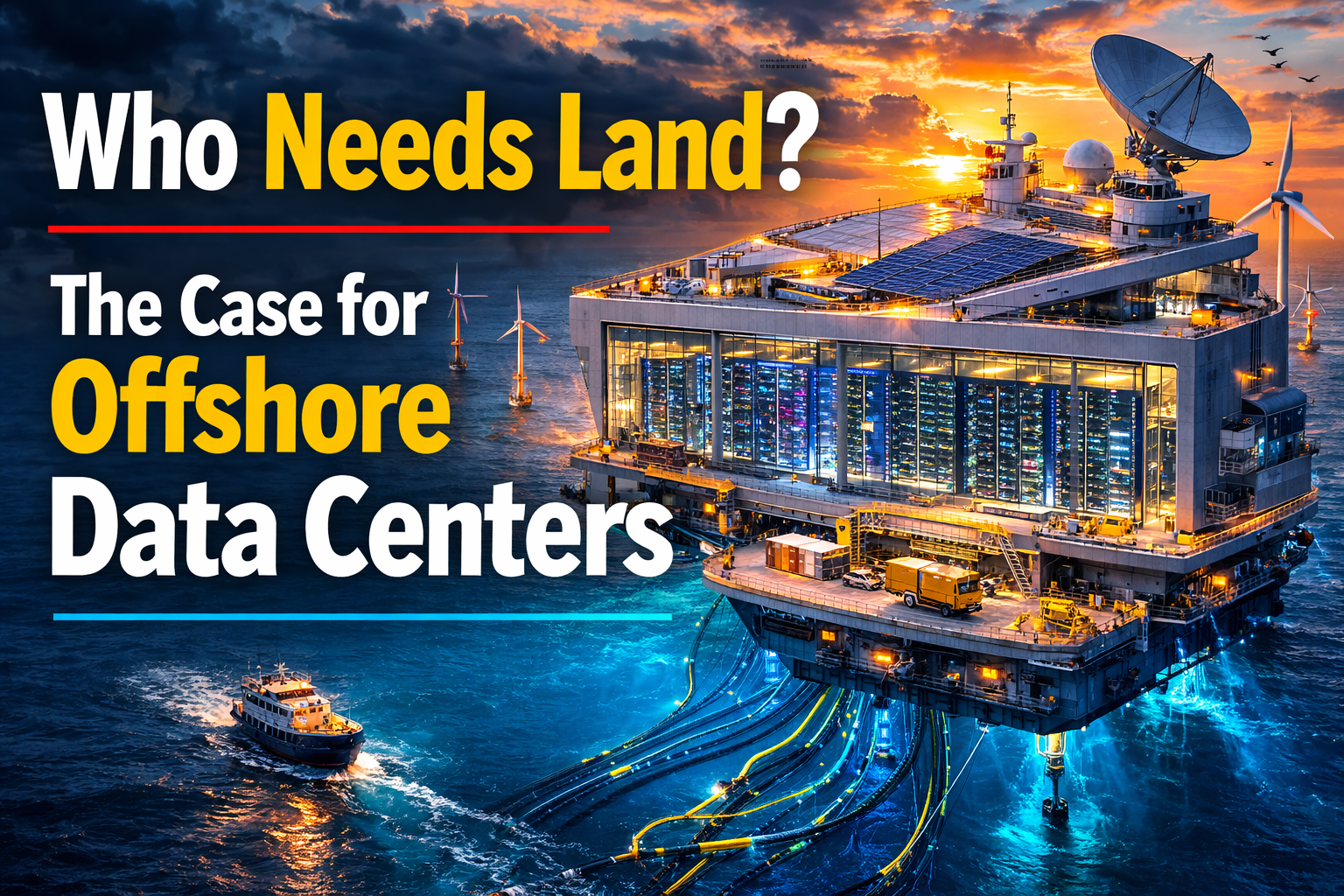
The data center industry is facing a trilemma that conventional land-based construction cannot easily solve. The AI boom has created an almost insatiable demand for compute infrastructure that requires enormous quantities of power, generates enormous quantities of heat that must be expelled, and needs to be built quickly at locations close enough to major internet exchange points to keep latency manageable.
Thank you for reading this post, don't forget to subscribe!Land scarcity near power-rich, fiber-connected locations is driving construction costs up. Power grid capacity in most developed markets is constrained enough that large data center projects face multi-year waits for utility connection approvals. And the environmental pressure around both water consumption for cooling and carbon footprint for power is intensifying.
Into this environment, the offshore floating data center concept is re-emerging not as a science fiction thought experiment but as a commercially serious proposal being developed by multiple organizations simultaneously. Understanding why the ocean floor and open sea might genuinely be better real estate for AI infrastructure than land requires understanding exactly what the land-based alternative costs.
The Land-Based Data Center Problem
Power Availability and Grid Constraints
A hyperscale data center for AI training requires hundreds of megawatts of reliable, low-carbon power. In the United States, applications for that scale of grid connection are queued in some regions for five to ten years. The Northern Virginia data center corridor, which hosts the highest concentration of data center capacity in the world, has triggered moratoriums on new connections from Dominion Energy due to grid stress.
The same constraints exist in most developed markets with strong internet infrastructure. Ireland has been restricting new data center connections in the Dublin region for several years. Singapore has paused new data center approvals multiple times. Power availability is the single largest constraint on AI infrastructure deployment speed, and it is a land-specific problem.
Cooling: The Water and Efficiency Problem
Conventional data centers use enormous quantities of water for cooling, with large facilities consuming millions of gallons per day for evaporative cooling systems. This water consumption is becoming a significant community and regulatory issue in water-stressed regions, adding a new dimension to the permitting challenges that data center developers already face.
Ocean water at depth is cold, abundant, and free. A data center on or near the ocean has access to the most efficient cooling medium available anywhere on Earth, available in unlimited quantities, with no water utility costs, no permitting issues, and a thermodynamic efficiency advantage over land-based alternatives that translates directly into lower power costs per unit of compute.
Microsoft’s Natick Project: Microsoft conducted a two-year undersea data center experiment called Project Natick, sinking a server-filled cylinder off the Scottish coast. The project achieved server failure rates significantly lower than land-based equivalents, attributed partly to the stable temperature, humidity, and nitrogen atmosphere of the sealed underwater container. The experiment ended but the findings validated core elements of the offshore data center thesis.
Why Offshore Floating Data Centers Make Engineering Sense
The Ship-Based Model
The most commercially developed offshore data center concept uses purpose-built ships or converted vessels as mobile data center platforms. The ship provides a self-contained power generation system using marine-grade diesel or LNG generators, natural seawater cooling through heat exchangers, and a mobile deployment capability that allows the data center to reposition to optimize for power costs, regulatory environments, or proximity to different network hubs.
The ship-based model has the additional advantage of being deployable at international locations that are not subject to any single nation’s regulatory framework, which is commercially attractive for AI training workloads where the operator wants maximum flexibility in terms of data sovereignty rules and export control compliance.
The Fixed Platform Model
An alternative approach uses fixed offshore platforms, similar to oil platform engineering, positioned in shallow coastal waters where submarine power cables from onshore renewable energy installations can provide more reliable and lower-carbon power than ship-based generators. Fixed platforms can accommodate larger and denser compute installations than ships and provide more stable operating environments for precision hardware.
The fixed platform model requires more capital investment upfront and lacks the mobility advantage of the ship model, but it enables the deployment scale that AI training workloads require and the renewable power integration that makes the environmental case for offshore data centers most compelling.
The Latency and Connectivity Question
The obvious concern about data centers at sea is network connectivity. AI training workloads that require massive data ingestion and output need high-bandwidth, low-latency connections to the internet backbone. Submarine cables already carry the vast majority of the world’s internet traffic between continents, and connecting a coastal offshore data center to the submarine cable infrastructure is an engineering challenge with well-understood solutions.
For AI training specifically, where jobs can run for days or weeks and data transfer occurs in large batches rather than requiring millisecond latency, the connectivity requirements are more manageable than for real-time application serving. The offshore data center case is strongest for training workloads and weakest for inference serving that requires the lowest possible latency to end users.
Who Is Building This
- Subsea Cloud: A startup specifically founded to build offshore data center infrastructure in international waters, with funding from major infrastructure investors
- Microsoft: Project Natick validated the technical approach, and Microsoft has continued research into ocean-based compute even as it has not yet announced commercial deployment
- Nauticus Robotics: Working on autonomous offshore platform technology that has data center applications among other use cases
- Multiple European operators: Exploring fixed offshore platforms in the North Sea where offshore engineering expertise from the oil industry is readily available
The Regulatory and Environmental Frontier
Operating data centers in international waters or in coastal offshore zones creates regulatory complexity that is genuinely unresolved. Data sovereignty laws apply to data based on where it is processed; an offshore data center in international waters creates novel questions about which legal jurisdiction’s rules apply to the data processed there.
The environmental case for offshore data centers is genuinely mixed. Seawater cooling is far more efficient than land-based alternatives, but the ecosystem impact of using large volumes of seawater as a heat sink, and the potential impact of platforms on marine environments, requires careful assessment. The offshore energy industry has decades of experience managing these environmental tradeoffs, and that expertise is directly applicable to offshore data center deployment.
Bottom Line: Offshore floating data centers are moving from concept to commercial development because the constraints on land-based AI infrastructure are becoming genuinely severe. The combination of power availability, cooling efficiency, and deployment speed advantages is real. The regulatory, connectivity, and environmental challenges are manageable rather than prohibitive. This is infrastructure worth watching closely.
Related: A16z $1.7B AI Infrastructure Fund | Seven Tech Giants Sign Trump Power Pledge | Anthropic Claude Outage Explained
Related Posts

Stay Informed With the Latest & Most Important News



Top News
- Google’s AI-Powered Workspace in Search Is Now Available to All US Users: Here Is What Actually Changed

- How Jeffrey Epstein Used Silicon Valley’s Network: What the Reporting on Reid Hoffman and Tech’s Elite Reveals

- Where to Preorder the iPhone 17E Right Now: Every Deal Ranked Before the March 11 Launch

- Google Apps Experience and Games Level Up: The Programs That Could Cut Your Play Store Commission Significantly

- Google Is Not Waiting for a Settlement: It Just Killed the 30 Percent App Store Fee Unilaterally














Advertisement