

Now Reading: Anduril Is Targeting a $60 Billion Valuation: Here Is Why the Defense Tech Startup Has Become One of America’s Most Valuable Private Companies
-
01
Anduril Is Targeting a $60 Billion Valuation: Here Is Why the Defense Tech Startup Has Become One of America’s Most Valuable Private Companies
Anduril Is Targeting a $60 Billion Valuation: Here Is Why the Defense Tech Startup Has Become One of America’s Most Valuable Private Companies

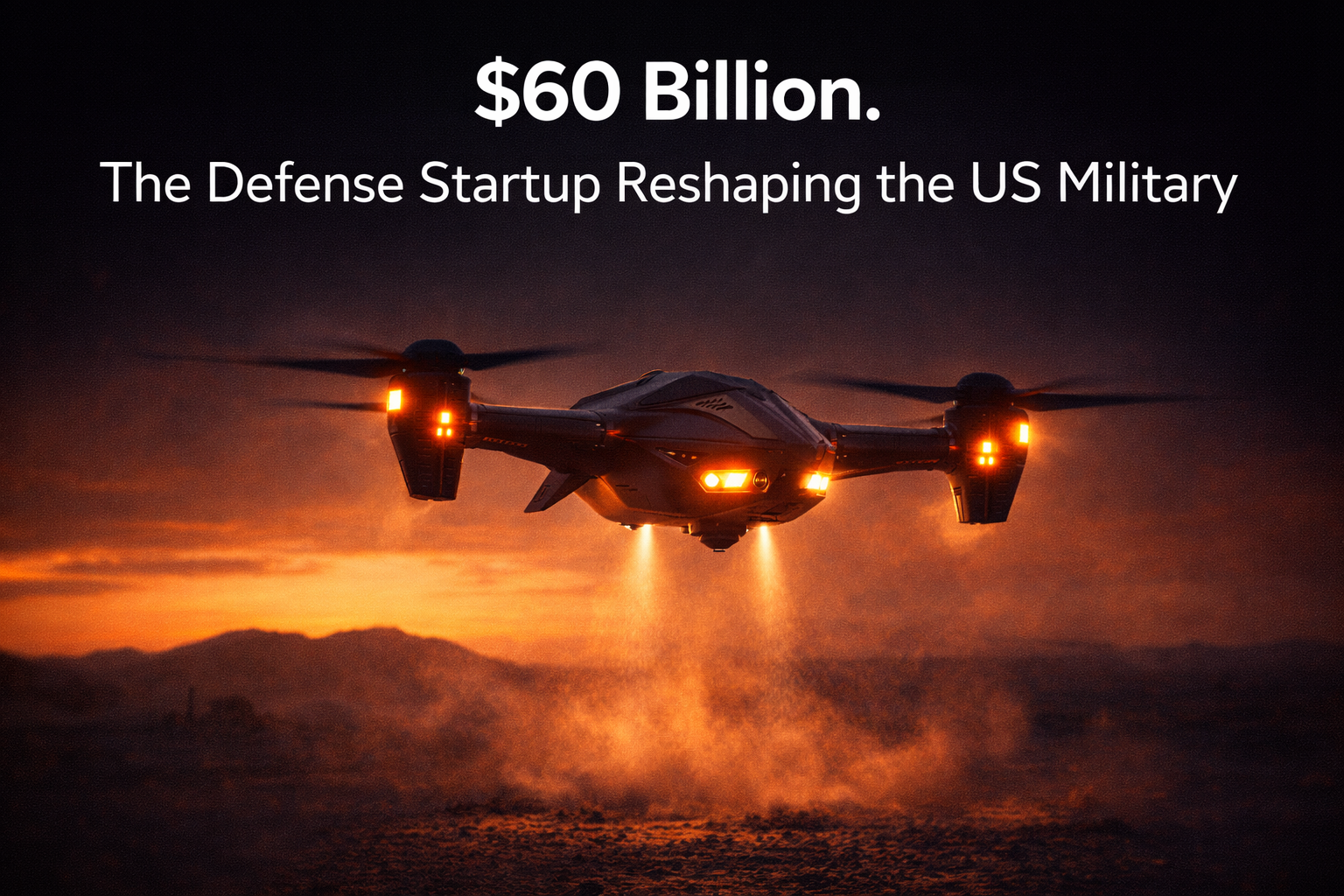
Palmer Luckey founded Oculus and sold it to Facebook for $2 billion before he was 22. He then started Anduril Industries in 2017 with a straightforward and contrarian thesis: the US defense establishment’s procurement model was fundamentally broken, the best engineering talent in America was working at consumer tech companies instead of defense, and a software-first defense company could build better systems faster and at lower cost than traditional defense primes.
Thank you for reading this post, don't forget to subscribe!Eight years later, Anduril is targeting a $60 billion valuation in a new funding round. The company is no longer a contrarian startup. It is one of the most consequential defense technology companies in America, and the capital it is raising reflects a military spending environment that has fundamentally shifted in its willingness to bet on non-traditional defense vendors.
What Anduril Actually Builds
Anduril’s product portfolio centers on autonomous systems, AI-powered command software, and integrated defense platforms that differ from traditional defense products in a critical way: they are designed to be software-defined and continuously updated, operating more like a modern consumer technology product than a traditional military procurement item that is fixed at the time of delivery.
Lattice: The AI Command and Control Platform
Lattice is Anduril’s flagship software platform, an AI-powered command and control system that integrates data from multiple sensors, drones, radar systems, and intelligence sources to give military operators a unified operational picture. Lattice can process information from heterogeneous sources in real time and surface decision-relevant information faster than human analysts can manually synthesize it from separate systems.
The platform has been deployed in real operations including border security applications and has been integrated into exercises and deployments by multiple US military branches. Unlike traditional defense software that requires years of acquisition and integration, Lattice is designed to be deployed rapidly and updated continuously, a model that maps to commercial software development rather than traditional defense procurement.
Autonomous Aerial and Underwater Systems
Anduril has developed a family of autonomous aerial vehicles under the Roadrunner and Ghost Shark product lines, along with underwater autonomous systems. These products are designed for missions where putting human operators at risk is unacceptable or operationally impractical: underwater surveillance, electronic warfare, intercepting drone threats, and persistent surveillance in contested environments.
The Roadrunner in particular represents a significant capability: an autonomous air vehicle designed to intercept drone threats and return to base for reuse, unlike single-use interceptor missiles that cost orders of magnitude more than the drones they destroy. The economic math of drone defense has been a persistent problem for militaries facing cheap drone attacks; Anduril’s approach addresses it directly.
The Drone Defense Economics: A military-grade surface-to-air missile can cost $1 million or more. The commercial drones increasingly used in asymmetric warfare can cost $500. Anduril’s reusable autonomous interceptors are designed to flip this economic equation, making drone defense economically sustainable at scale.
Why the $60 Billion Valuation Makes Strategic Sense
The Defense Budget Context
US defense spending has been expanding, and the shift toward autonomous systems, AI-enabled warfare, and counter-drone capabilities is driving procurement changes that favor Anduril’s product portfolio over traditional defense prime offerings. The wars in Ukraine and Gaza have provided real-world validation of the strategic importance of autonomous systems and drone warfare that has accelerated US military interest in Anduril-style capabilities.
The Pentagon’s acquisition reform efforts, while slow, have been creating pathways for non-traditional defense vendors to win contracts that previously would have been inaccessible without the established relationships and compliance infrastructure of legacy primes.
The Traditional Defense Prime Comparison
Lockheed Martin, Raytheon, Northrop Grumman, and General Dynamics are valued at between $50 billion and $150 billion each with decades of revenue, established government relationships, and massive physical manufacturing infrastructure. Anduril’s $60 billion target puts it in the same league as these established giants based on growth trajectory and strategic positioning rather than current revenue.
The argument for this valuation is that Anduril’s software-first approach, AI integration, and willingness to use commercial development practices gives it a structural advantage in the weapons systems categories where the US military most urgently needs to accelerate: autonomous systems, counter-drone, and AI-enabled command and control.
The Broader Defense Tech Investment Wave
Anduril’s fundraising is the most visible part of a broader investment wave into defense technology. The Russian invasion of Ukraine in 2022 was a watershed moment for defense tech investment, demonstrating in real time the strategic importance of capabilities like drones, electronic warfare, and autonomous systems. Capital that had previously avoided defense on ethical or commercial grounds began flowing into the sector.
This capital shift has created a new category of defense technology company: venture-backed, software-focused, able to recruit top engineering talent from consumer tech companies, and willing to move at development speeds that traditional defense primes cannot match.
- Palantir: AI-powered defense analytics and operational decision support
- Shield AI: AI pilot for autonomous aircraft and drone systems
- Sarcos: Exoskeleton and robotic systems for military and industrial use
- True Anomaly: Autonomous spacecraft for space domain awareness
- Rebellion Defense: Software platform for defense AI applications
Bottom Line: Anduril’s $60 billion target is not a speculative number. It reflects a defense technology market where the US military is urgently investing in autonomous systems and AI capabilities that traditional defense primes have been slow to develop. Anduril has positioned itself at the center of that investment, and the capital markets are responding accordingly.
Related: Anthropic Pentagon Blacklist | ChatGPT DoD Deal Backlash | Defense Tech Companies Dropping Claude
Anduril Industries official site
Related Posts

Stay Informed With the Latest & Most Important News



Top News
- Google’s AI-Powered Workspace in Search Is Now Available to All US Users: Here Is What Actually Changed

- How Jeffrey Epstein Used Silicon Valley’s Network: What the Reporting on Reid Hoffman and Tech’s Elite Reveals

- Where to Preorder the iPhone 17E Right Now: Every Deal Ranked Before the March 11 Launch

- Google Apps Experience and Games Level Up: The Programs That Could Cut Your Play Store Commission Significantly

- Google Is Not Waiting for a Settlement: It Just Killed the 30 Percent App Store Fee Unilaterally














Advertisement