
Now Reading: Why AI Startups Are Selling the Same Equity at Two Different Prices and What It Means for the Industry
-
01
Why AI Startups Are Selling the Same Equity at Two Different Prices and What It Means for the Industry
Why AI Startups Are Selling the Same Equity at Two Different Prices and What It Means for the Industry

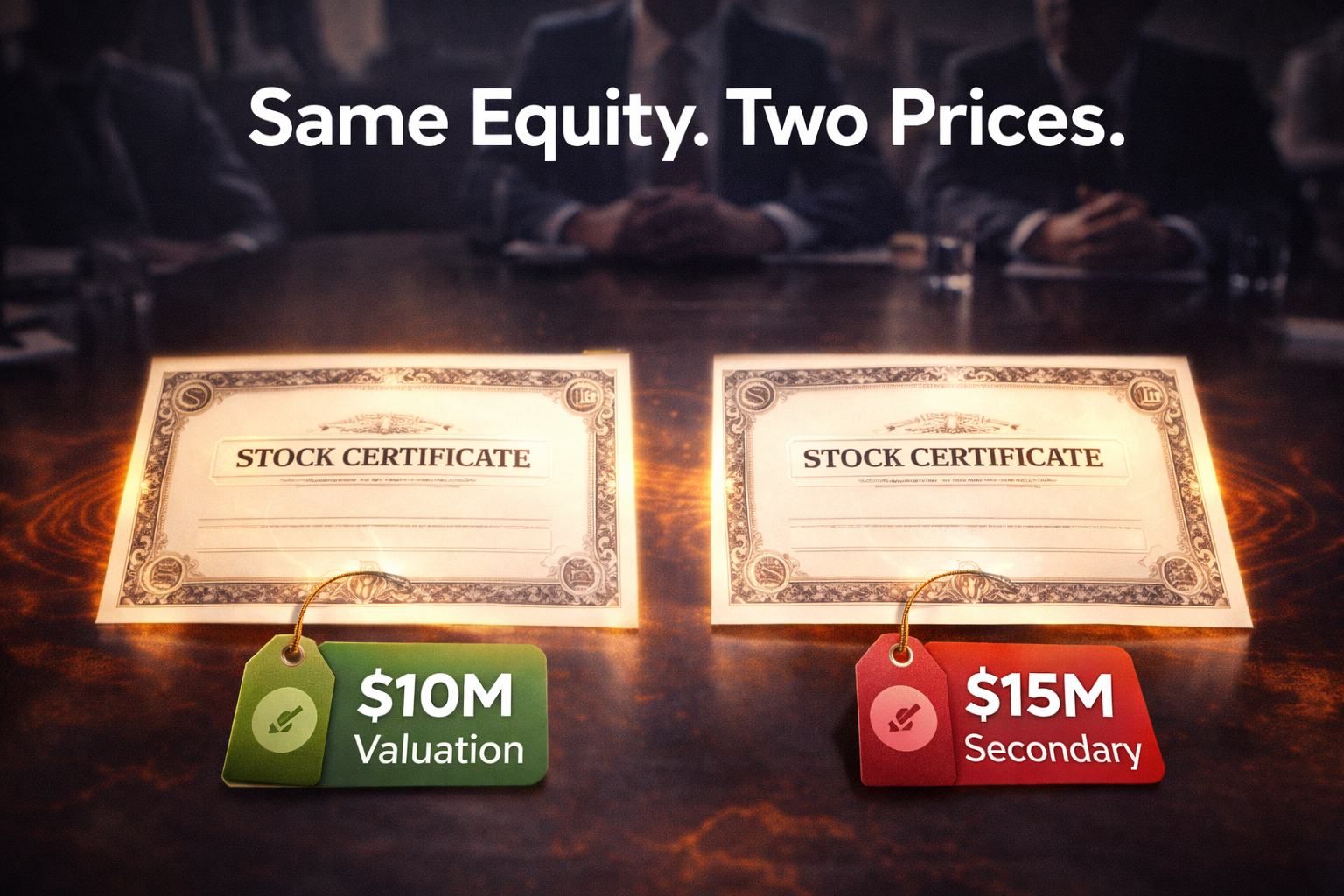
Something structurally unusual is happening in AI startup financing in 2025. Founders and early investors are watching the same equity being valued at dramatically different prices depending on who the buyer is, what stage the transaction occurs at, and what secondary market conditions look like versus primary round terms.
Thank you for reading this post, don't forget to subscribe!This is not a new phenomenon in venture capital broadly, but the scale and speed at which it is occurring in AI specifically has created pricing dislocations that are forcing everyone from seed-stage founders to late-stage growth equity investors to recalibrate how they think about valuation, dilution, and what a share in an AI company is actually worth.
The Two Prices: Primary Rounds vs. Secondary Transactions
The clearest expression of the dual-pricing phenomenon is the gap between primary funding round valuations and secondary market transaction prices for the same company. In a primary round, a company raises new capital at a price per share that reflects the company’s negotiated valuation with a lead investor who conducts full due diligence and sets the terms.
In secondary transactions, existing shareholders, typically employees, early investors, or former employees, sell their existing shares to buyers who want AI exposure without waiting for a primary round or an IPO. These transactions occur at prices that are determined by supply and demand dynamics in the secondary market, which can diverge significantly from primary round pricing in both directions.
The Gap in Practice: It is now common to see an AI startup that raised its last primary round at a specific valuation trading on secondary markets at a 30 to 50 percent premium to that valuation because institutional buyers cannot access the primary round and are willing to pay up for secondary exposure. Simultaneously, less prominent AI startups may see secondary transactions at steep discounts to their last primary valuation.
Why This Pricing Dislocation Is Uniquely Severe in AI
The Access Problem
The most consequential AI companies, OpenAI, Anthropic, xAI, and a handful of infrastructure startups, are raising primary capital from a small group of hyperscaler investors and sovereign wealth funds that have preferential access. Most institutional investors who want meaningful AI exposure cannot get allocation in primary rounds at any price.
This scarcity of primary access drives secondary market buyers to pay premiums that would look irrational by any conventional valuation methodology. When Fidelity or a pension fund is choosing between zero AI exposure and paying a 40 percent premium over the last primary valuation for secondary shares, many choose the premium. The alternative, no exposure to the AI theme in a portfolio, is increasingly seen as its own risk.
The Revenue Multiple Problem
AI companies are being valued at revenue multiples that have no historical precedent outside of the earliest days of cloud software. When a company generating $100 million in annual recurring revenue is valued at $50 billion in a primary round, the implied 500x revenue multiple cannot be justified by any conventional discounted cash flow analysis. It can only be justified by assumptions about the total addressable market for AI services that are themselves speculative.
The secondary market, operating on real-time supply and demand rather than negotiated round terms, sometimes prices the same company more rationally and sometimes less rationally than primary rounds. The result is that the two prices for the same equity reflect two genuinely different theories about what an AI company is worth, with no clean mechanism to arbitrate between them.
The Tender Offer Mechanism: A Third Price
Complicating the picture further is the tender offer, a company-organized secondary transaction that allows employees and early investors to sell shares at a price set by the company itself. Decagon’s recent completion of its first tender offer at a $4.5 billion valuation is a current example. The tender offer price reflects what the company and its board believe the shares are worth at a given moment, filtered through their interest in managing the secondary market perception of their valuation.
Tender offer prices frequently diverge from both primary round valuations and open secondary market transaction prices, creating a third data point that adds to rather than resolves the valuation ambiguity. For employees trying to understand what their equity is actually worth, the existence of three different prices for the same shares is genuinely confusing.
Why Companies Run Tender Offers at Specific Valuations
- Liquidity for employees who would otherwise sell on the open secondary market at potentially lower prices
- Control over who buys the company’s shares and at what price
- Narrative management: setting a visible valuation benchmark that supports the primary round story
- Employee retention: converting paper equity gains into real liquidity reduces pressure to leave for roles with earlier liquidity events
- Cap table hygiene: consolidating small employee shareholdings into fewer, larger institutional positions
What Investors Are Actually Looking For in AI SaaS in 2025
The dual-pricing phenomenon has forced a clarification in what sophisticated investors claim to be seeking in AI company investments. Presentations from AI-focused partners at major VC firms increasingly emphasize defensibility, proprietary data, workflow integration depth, and switching costs as the criteria that justify primary round valuations.
The implicit acknowledgment in this emphasis on defensibility is that investors are concerned about the specific risk that has materialized in previous software cycles: the commoditization of capabilities that once commanded premium multiples once the underlying technology becomes widely accessible. For AI, the concern is that foundation model capabilities that today require custom development will be available as commodity API calls within 18 to 24 months, collapsing the moat of any AI company built primarily on model capability rather than data or workflow integration.
What Founders Should Know About This Moment
For AI founders currently raising or planning to raise, the dual-pricing environment creates both opportunity and risk. The opportunity is that the secondary market premium for AI exposure means your existing shareholders can access liquidity at favorable prices, which reduces pressure on you to optimize for an early exit.
The risk is that the gap between primary and secondary pricing can create misaligned incentives within your cap table. Employees and early investors who can sell at secondary market premiums may have different time horizons and risk tolerances than primary round investors who are locked into their positions. Managing those competing interests while maintaining focused execution is a real operational challenge.
Bottom Line: The dual-pricing phenomenon in AI startup equity is a product of genuine scarcity, speculative enthusiasm, and the structural limitations of how private market capital flows. It is neither purely rational nor purely irrational. Founders, investors, and employees all need to understand which price they are operating at and why, because the answer affects every major financial decision they make.
Related: A16z $1.7B AI Infrastructure Fund | Decagon $4.5B Tender Offer | What Investors No Longer Want in AI SaaS
Pitchbook AI funding data 2025
Related Posts

Stay Informed With the Latest & Most Important News


Top News
- Google’s AI-Powered Workspace in Search Is Now Available to All US Users: Here Is What Actually Changed
- How Jeffrey Epstein Used Silicon Valley’s Network: What the Reporting on Reid Hoffman and Tech’s Elite Reveals
- Where to Preorder the iPhone 17E Right Now: Every Deal Ranked Before the March 11 Launch
- Google Apps Experience and Games Level Up: The Programs That Could Cut Your Play Store Commission Significantly

- Google Is Not Waiting for a Settlement: It Just Killed the 30 Percent App Store Fee Unilaterally












Advertisement