

Now Reading: How Elon Musk Is Rewriting Every Rule About Founder Power and Why Silicon Valley Is Watching
-
01
How Elon Musk Is Rewriting Every Rule About Founder Power and Why Silicon Valley Is Watching
How Elon Musk Is Rewriting Every Rule About Founder Power and Why Silicon Valley Is Watching

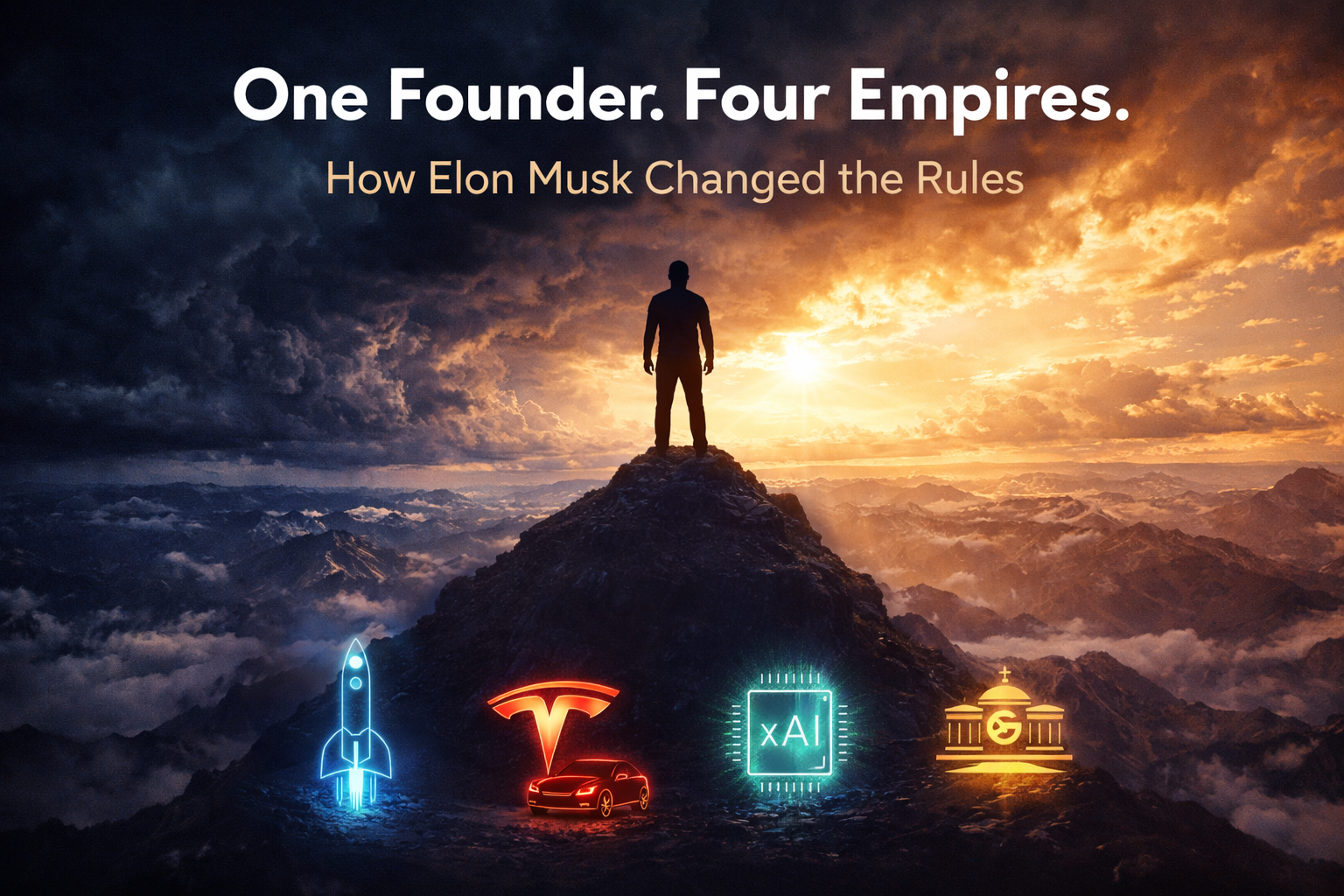
The Silicon Valley founder mythology has always celebrated concentrated vision and strong founder control. Steve Jobs returning to Apple and making unilateral product decisions. Jeff Bezos resisting Wall Street pressure to keep Amazon investing for the long term. Mark Zuckerberg maintaining voting control of Meta through a dual-class share structure that lets him override any shareholder vote.
Thank you for reading this post, don't forget to subscribe!Elon Musk has taken this tradition and expanded it into territory that none of those founders approached. The simultaneous control of Tesla, SpaceX, xAI, and significant operational influence over government policy through the Department of Government Efficiency represents a concentration of corporate and governmental power in a single individual that has no modern parallel in a democratic society. The rules being rewritten are not just Silicon Valley conventions. They are assumptions about how power is distributed in corporate governance, democratic institutions, and the technology industry.
The Four Domains of Musk’s Power Concentration
Tesla: The Public Company Exception
Tesla’s board structure and Musk’s compensation package have been among the most controversial in corporate governance history. His attempt to secure a $56 billion compensation award was rejected by Delaware courts, leading to Tesla’s reincorporation in Texas. The Delaware ruling was explicit: the board process that approved the compensation was not sufficiently independent of Musk’s influence to be considered arms-length governance.
Musk’s response was to move Tesla to a more permissive jurisdiction and continue seeking shareholder approval for the compensation. The episode illustrates a pattern: when existing governance rules constrain his preferred outcome, Musk finds a different ruleset to operate under rather than accepting the constraint.
SpaceX: The Privately Controlled National Asset
SpaceX has effectively become a strategic national asset while remaining a private company. Starlink satellite internet serves US military communications, provides critical internet infrastructure for Ukraine, and has been granted orbital spectrum rights that make it a de facto public infrastructure provider. Yet SpaceX remains private, with Musk maintaining majority control over its direction without the accountability mechanisms that public company status or government ownership would require.
The privatization of national space infrastructure in a single founder’s hands creates dependencies that have already manifested in geopolitically sensitive moments, including Musk’s reported decision to restrict Starlink connectivity over Crimea during the Ukraine conflict. A private founder’s personal judgment was applied to a military and humanitarian situation with profound real-world consequences.
xAI: The AI Lab That Moves Fast
xAI, Musk’s AI laboratory and the creator of the Grok AI models, was founded with an explicit critique of OpenAI’s direction and a promise of less constrained AI development. The lab has scaled rapidly, with xAI acquiring significant GPU infrastructure and releasing competitive models at a pace that suggests substantial organizational resources.
Reporting on talent departures from both OpenAI and xAI suggests that xAI’s internal culture, while moving fast, has the same founder-dependency and mission-alignment tensions that affect every organization where a dominating personality’s priorities can shift rapidly and unpredictably.
DOGE: Where Corporate Governance Meets Government
The Department of Government Efficiency, an informal advisory body without statutory authority, has been Musk’s most audacious governance experiment. Operating with direct presidential backing, DOGE has accessed government data systems, conducted mass agency reviews, and influenced personnel decisions across the federal government in ways that have no clear legal precedent or accountability structure.
The constitutional and legal questions about DOGE’s authority are actively being litigated. What is not in question is that Musk has successfully operated as a de facto government official without the typical appointment, confirmation, and oversight processes that govern federal power. This is a new form of founder power: the extension of Silicon Valley’s move-fast culture into the federal bureaucracy.
Unprecedented Combination: No individual in modern American history has simultaneously run companies that control national space infrastructure, electric vehicle production, frontier AI development, and wielded direct governmental influence over federal agencies. The rules were simply not designed for this scenario.
Why Silicon Valley Is Paying Close Attention
Silicon Valley is watching Musk’s rulebook rewriting with a combination of admiration, concern, and opportunism. The founder community’s sympathy for strong founder control is genuine but mostly operates within the assumption that corporate governance structures provide some minimum check on individual power. Musk has demonstrated that those checks are more negotiable than assumed.
The investment community is also paying attention for strategic reasons. Companies with Musk’s involvement attract capital, talent, and media attention in ways that no other founder reliably produces. The Musk premium on any company he touches is a real financial phenomenon that distorts normal valuation frameworks.
The Governance Vacuum and Its Risks
The rules Musk is rewriting are not just inconvenient formalities. Corporate governance, public company accountability, government appointment processes, and institutional checks on individual power exist because history has repeatedly demonstrated what happens when they are absent. The concentration of corporate and governmental influence in a single individual creates specific risks: inconsistency as personal priorities shift, conflicts of interest between commercial and public interests, and the elimination of the deliberative processes that catch bad decisions before they become consequential.
Whether those risks materialize in ways that cause serious harm, or whether Musk’s track record of operational success across multiple ventures justifies the reduced governance oversight, is a live and unresolved question that the next several years will answer empirically.
Bottom Line: Elon Musk is not just breaking rules. He is demonstrating that the rules can be broken, which creates permission structures for every founder who follows. Silicon Valley will not return to conventional governance norms after this era, regardless of how Musk’s individual ventures resolve. The Pandora’s box of extreme founder power is open.
Related: Why Top Talent Is Leaving OpenAI and xAI | SpaceX Going Public | The Candidate Silicon Valley Built and Now Wants to Tear Down
Stay Informed With the Latest & Most Important News


Top News
- Google’s AI-Powered Workspace in Search Is Now Available to All US Users: Here Is What Actually Changed
- How Jeffrey Epstein Used Silicon Valley’s Network: What the Reporting on Reid Hoffman and Tech’s Elite Reveals
- Where to Preorder the iPhone 17E Right Now: Every Deal Ranked Before the March 11 Launch

- Google Apps Experience and Games Level Up: The Programs That Could Cut Your Play Store Commission Significantly

- Google Is Not Waiting for a Settlement: It Just Killed the 30 Percent App Store Fee Unilaterally












Advertisement