

Now Reading: ChatGPT Uninstalls Jumped 295% After the Pentagon Deal: What That Number Actually Tells Us
-
01
ChatGPT Uninstalls Jumped 295% After the Pentagon Deal: What That Number Actually Tells Us
ChatGPT Uninstalls Jumped 295% After the Pentagon Deal: What That Number Actually Tells Us

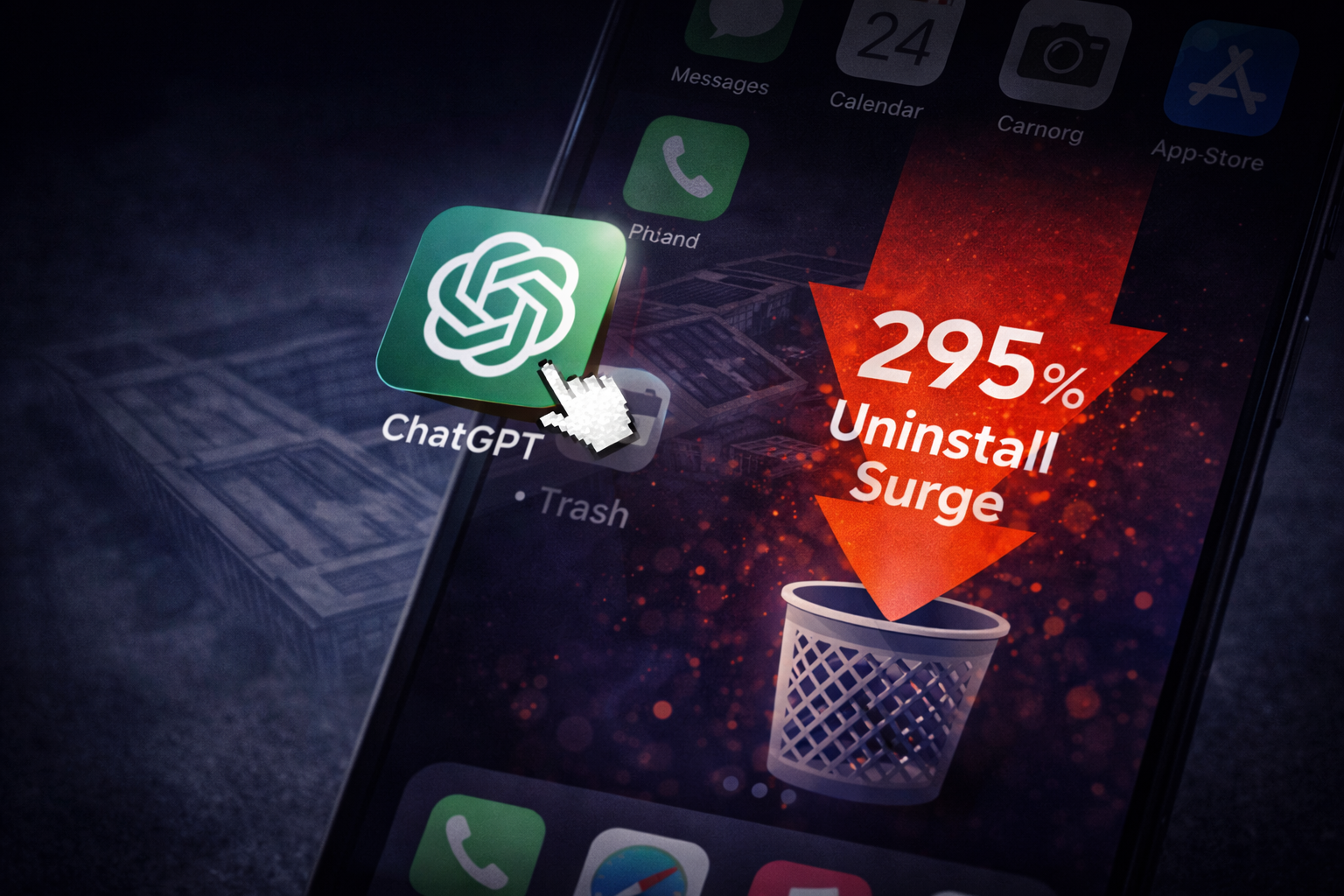
Numbers like 295% tend to get attention. When app uninstall data showed that ChatGPT deletions surged by nearly three times their normal rate in the period immediately following OpenAI’s announcement of a Department of Defense partnership, the technology and AI ethics communities took notice.
Thank you for reading this post, don't forget to subscribe!The surge in uninstalls does not mean ChatGPT is in trouble as a product. With hundreds of millions of users, a three-times spike in uninstalls represents a small fraction of the total base. What it represents is something more important: a visible and measurable expression of user sentiment about AI companies partnering with military institutions, and a signal that a segment of ChatGPT’s user base had deeply held views about where that line should be drawn.
What OpenAI’s DoD Deal Actually Involves
OpenAI’s partnership with the Department of Defense expanded the permissible use cases for its models in military contexts beyond the previously stated restrictions. The exact scope of the agreement encompasses cybersecurity applications, logistics optimization, analysis tools, and operational planning support, though the precise details of which models are deployed for which applications are not fully public.
The significance is in what changed. OpenAI had previously maintained explicit restrictions on using its models for weapons development, direct lethal force decision-making, and certain military applications. The DoD partnership required revising those policies in ways that were publicly visible in OpenAI’s updated usage guidelines, which is what triggered the user response.
The Policy Change That Mattered: OpenAI’s original usage policies explicitly prohibited military and warfare applications. The revised policies opened specific military use cases under a framing of supporting national security and defense applications with appropriate oversight. That linguistic shift was enough to generate significant backlash from users who had chosen ChatGPT partly because of its stated ethical commitments.
Why 295% Matters Even if It Is a Small Absolute Number
The uninstall spike is significant for reasons that go beyond its raw size. Consumer AI tools exist in a trust economy. Users choose which AI assistant to invest their habits, data, and workflows in partly based on their perception of the company’s values and commitments. When those perceived commitments change visibly, some users reassess.
The 295% figure is also a measurable proxy for a sentiment that is much larger than the uninstall count suggests. For every user who uninstalled ChatGPT, there are likely many more who saw the news, felt uncomfortable, and did nothing because switching costs are real and alternatives are imperfect. The uninstall number is the tip of a sentiment iceberg.
Who Was Uninstalling and Why
The users most likely to act on the DoD news were those who chose ChatGPT with some awareness of or concern about AI ethics, researchers, academics, civil society professionals, journalists, and technically sophisticated users who follow AI policy closely. These are not necessarily ChatGPT’s most commercially valuable users by revenue metrics, but they are disproportionately influential in the conversations that shape AI’s public perception and policy environment.
Losing this segment of the user base, even partially, has implications for OpenAI’s reputation with the academic and research community, its relationships with employees who share similar concerns, and its standing in AI policy debates where user trust data becomes evidence.
The Broader AI and Military Ethics Debate
OpenAI’s DoD deal lands in the middle of an unresolved and genuinely difficult debate about the appropriate role of AI companies in military applications. The absolutist position, that AI companies should refuse all military partnerships unconditionally, ignores the reality that AI used defensively in cybersecurity, logistics, and intelligence analysis may reduce harm rather than increase it.
The permissive position, that commercial AI companies should accept any legal government contract without ethical restrictions, ignores the specific characteristics of AI systems that make their military application qualitatively different from conventional defense procurement. Autonomous decision-making systems, surveillance capabilities, and persuasion tools in military contexts raise ethical questions that require more nuanced frameworks than standard defense contracting.
Anthropic’s Contrast Moment
The timing of the ChatGPT uninstall story created an ironic contrast with Anthropic’s situation. Anthropic, which has marketed itself as the safety-focused AI lab, was simultaneously being blacklisted by the Pentagon as a supply chain risk, while OpenAI was expanding its military partnership. The two companies ended up on opposite sides of the military AI debate despite both having safety-oriented founding narratives.
Dario Amodei’s response, calling OpenAI’s messaging around the military deal dishonest, added a layer of public acrimony to what was already a commercially sensitive moment for both companies.
What AI Companies Can Learn From the Uninstall Spike
The ChatGPT uninstall data is a case study in what happens when AI companies make significant policy changes without sufficient transparency about the reasoning, the safeguards, and the limits of the new policy. Users who feel blindsided by changes to the ethical commitments they believed they were endorsing respond by reducing their engagement with the product.
The lesson is not that AI companies should avoid government partnerships. It is that trust requires consistent communication about values, advance warning when those values are being recalibrated, and credible explanations of how safeguards work in practice rather than in press releases.
- Be specific about what military use cases are and are not permitted
- Publish the reasoning behind policy changes with the same prominence as the changes themselves
- Create meaningful external oversight mechanisms that users can trust rather than just internal review
- Acknowledge that some users will disagree with partnership decisions and give them honest information to make their own choices
Bottom Line: A 295% uninstall spike is a warning signal that matters disproportionately to its absolute size. OpenAI’s DoD deal may be commercially and strategically justified, but the user response reveals that trust in AI platforms is fragile and context-dependent in ways that purely financial metrics do not capture.
Related: Anthropic Pentagon Blacklist Explained | OpenAI GPT-5.3 What Is New | AI Ethics in 2025: Where the Lines Are

Stay Informed With the Latest & Most Important News



Top News
- Google’s AI-Powered Workspace in Search Is Now Available to All US Users: Here Is What Actually Changed

- How Jeffrey Epstein Used Silicon Valley’s Network: What the Reporting on Reid Hoffman and Tech’s Elite Reveals
- Where to Preorder the iPhone 17E Right Now: Every Deal Ranked Before the March 11 Launch

- Google Apps Experience and Games Level Up: The Programs That Could Cut Your Play Store Commission Significantly

- Google Is Not Waiting for a Settlement: It Just Killed the 30 Percent App Store Fee Unilaterally













Advertisement